


Ship with signals, not surprise pages
Deploys go out, incidents open, and release notes lag the tag. WEXTL notifies the right channels, pages on severity, and keeps environments aligned — on a canvas the whole team can read.
Deploys this workflow into your workspace — you'll connect your own accounts.
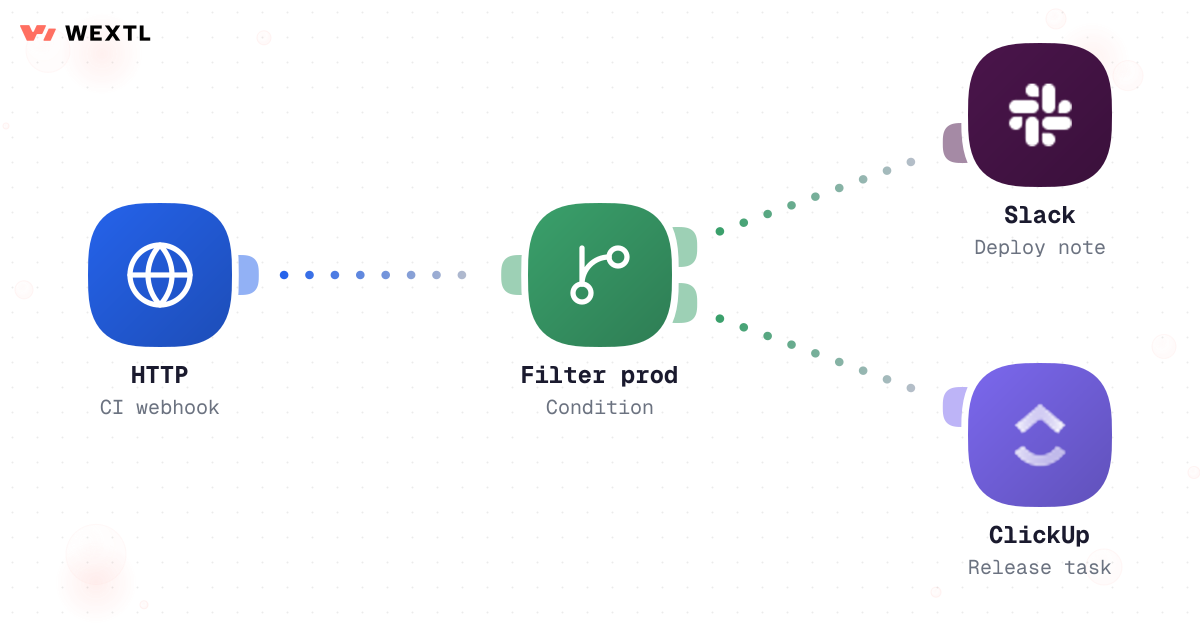
Workflow notifying Slack and ClickUp from CI deploy webhook
- GDPR
- Data Encryption
- 2FA
- Local Data Region
- 4
- manual steps before the first incident update
- 3
- places a shipped deploy gets announced by hand
- 1
- canvas for deploy, incident, release, and drift
* Illustrative example, not measured customer data.
DevOps automation, at a glance
DevOps loops on one canvas
Deploy notifications that stick
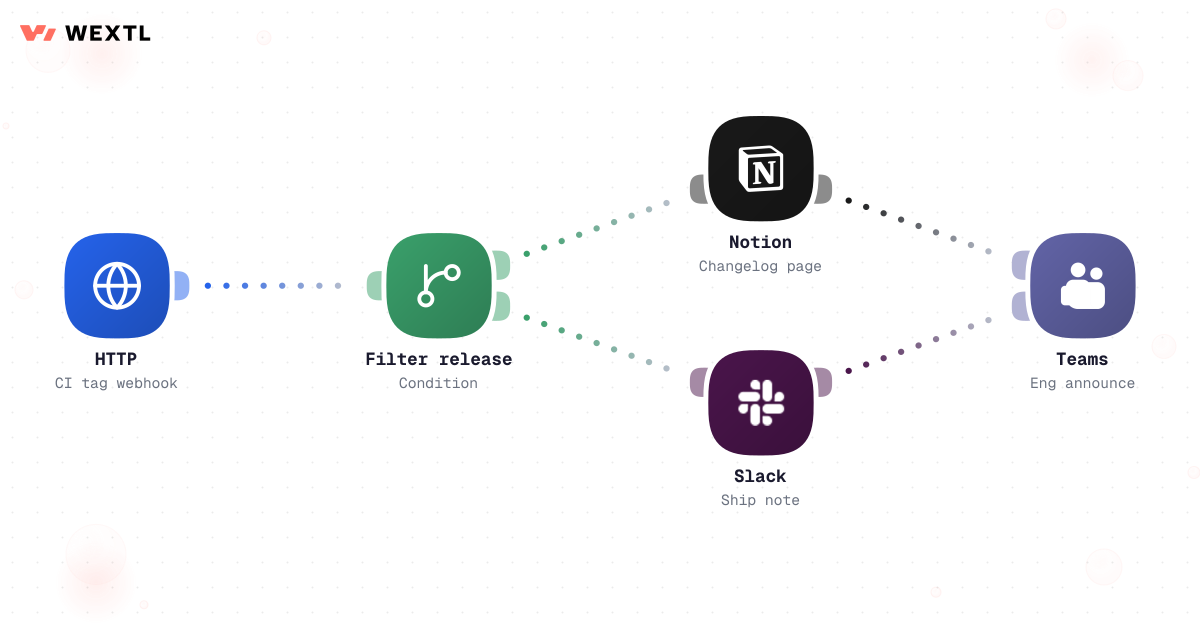
HTTP webhook from CI, branch on environment, notify Slack and ClickUp.
- Trigger — your CI/CD pipeline posts a webhook when a deploy job finishes (GitHub Actions, or any system that can call an HTTP endpoint).
- Information collected — repository and branch, target environment (staging vs. prod), commit SHA, deployer, and build status.
- Connected applications — GitHub for commit and PR context, Slack for the deploy channel, Jira or ClickUp for the linked change ticket.
- Decision logic — branches on environment (prod always notifies; staging only if you've opted that channel in) and on build status (a failed build routes to a different channel than a clean deploy).
- AI step — turns the commit list into a one-line plain-language summary for the announcement instead of a raw commit dump.
- Human approval — a production deploy outside the approved release window (a Friday-afternoon freeze, a launch-week lock) holds for a manual go-ahead before it notifies; in-window deploys post automatically.
- Actions — posts a threaded Slack message, updates the linked Jira or ClickUp ticket to "Deployed," and logs the run.
- Exception handling — a webhook missing a commit SHA or environment field is flagged instead of posted blind; a CI retry is deduped on deploy ID so the channel doesn't see the same deploy twice.
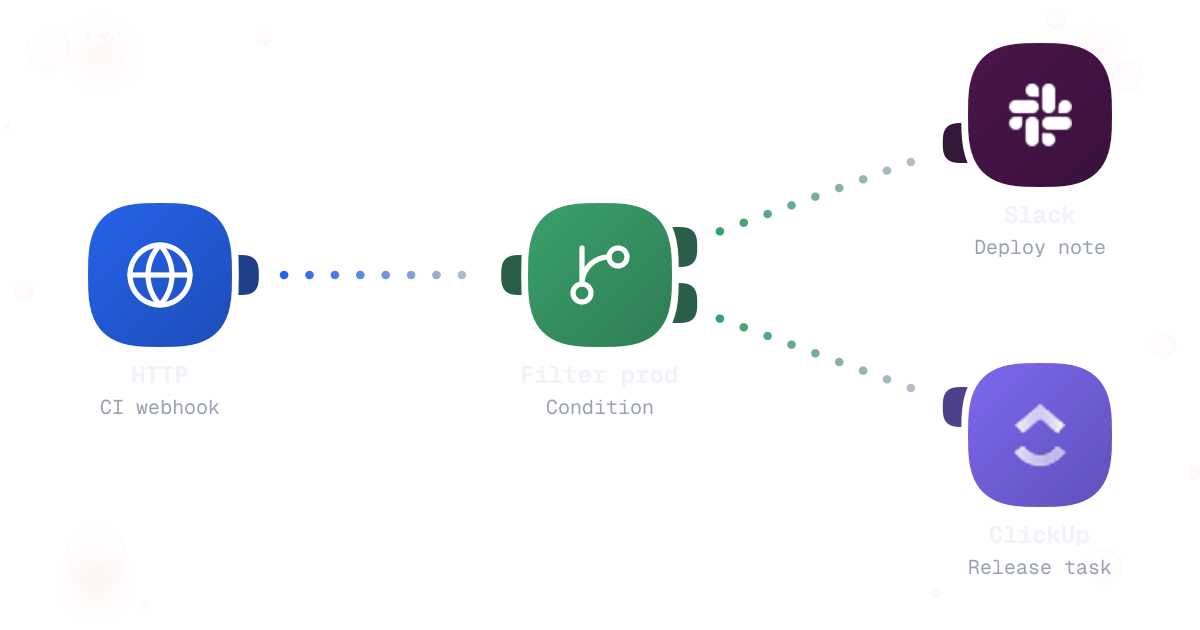
Workflow notifying Slack and ClickUp from CI deploy webhook
What actually eats a DevOps engineer's afternoon
An alert fires and the first minutes go to logistics, not the incident: finding the severity level, opening a war-room channel, pasting the monitor link into Slack, and updating the ticket — four separate steps before a customer sees any status at all.
A deploy that actually shipped gets announced by hand in three places — the team chat, the change ticket, and sometimes a release doc nobody re-reads later — and none of them update each other when the next deploy goes out an hour later.
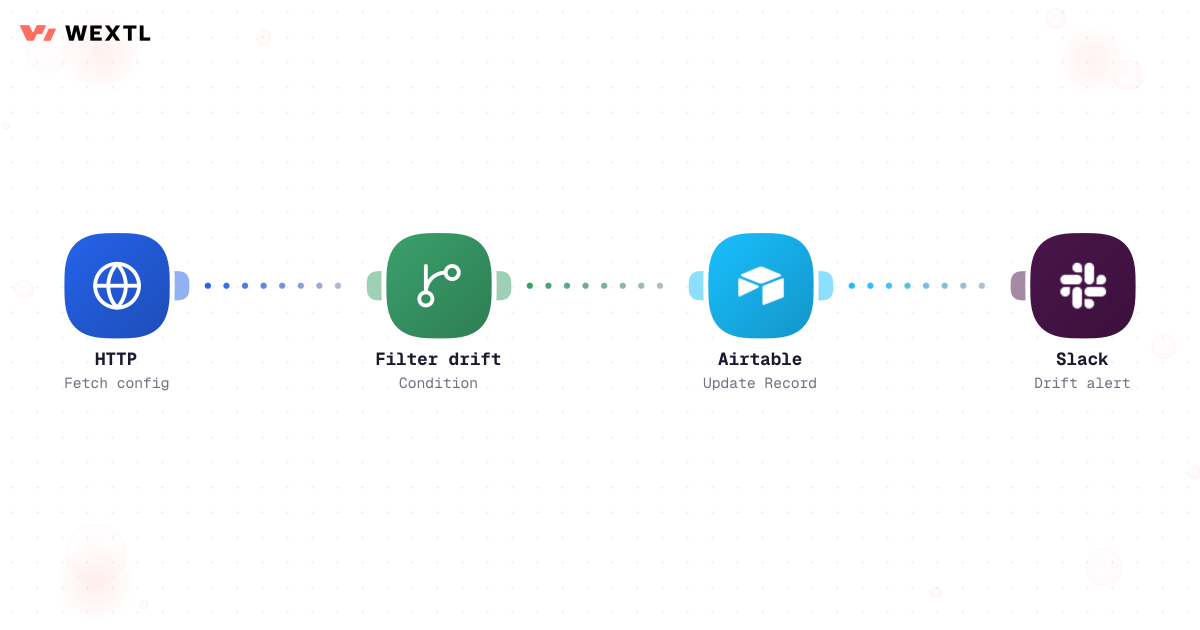
Meanwhile staging and prod drift apart quietly. Nobody schedules a config diff; it gets discovered the next time something behaves differently in prod than it did in staging an hour earlier.
Paging without a playbook
Four manual steps before the first status update, every time a page fires.
Announcing a deploy by hand
Chat, ticket, and doc — pasted separately, none of them synced.
Drift found the hard way
Staging and prod disagree, and nobody finds out until prod misbehaves.
None of this needs an engineer's judgment. All of it needs to happen the exact same way, every single time.
Example: automate incident paging and the war-room stand-up
A concrete run, start to finish — the kind of incident workflow a platform team clones from the template library and wires to their own monitor and severity levels.
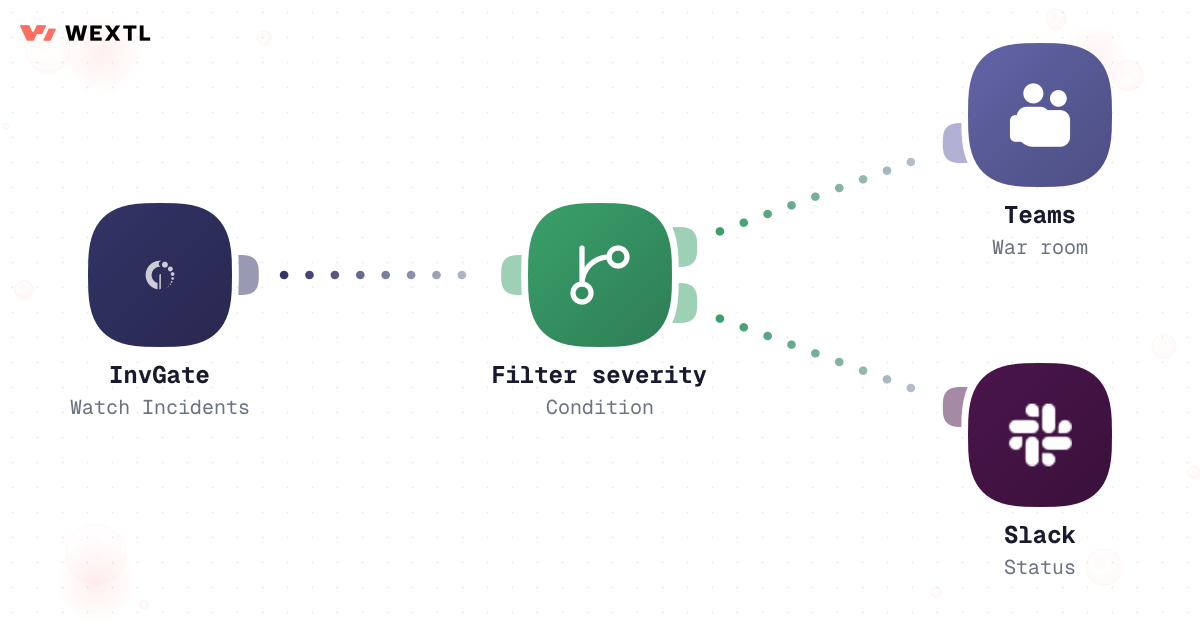
Trigger: a monitor or ITSM system opens or updates an incident — an alert fires, or an InvGate ticket is created with a severity field set.
WEXTL checks: the severity value, the affected service, whether it's inside or outside business hours, and whether an incident for the same alert is already open.
Human judgment
Root cause, the rollback decision, and the tone of the customer-facing message stay with the engineer on call. The workflow opens the room, pages the right person, and holds the draft — it doesn't declare the incident resolved or speak to customers on its own.
- Step 1
1. Alert fires and dedupes
A monitor or ITSM system opens the incident; a repeat alert for one already open is deduped instead of opening a second war room.
- Step 2
2. Read severity
SEV1 branches one way, SEV2/3 another, a warning a third.
- Step 3
3. Open the war room and page the rotation
SEV1 creates a dedicated Teams channel and pages the on-call owner and backup in Slack; lower severity posts to the standing channel.
- Step 4
4. Draft the status line
AI drafts a first customer-facing status update from the incident description.
- Step 5
5. Hold for sign-off
The draft waits for the on-call engineer before it reaches a public channel.
- Step 6
6. Post, log, and track to resolution
The confirmed status goes out, every step writes to the InvGate ticket and run history, and status updates through acknowledged, mitigated, and closed.
WEXTL doesn't replace on-call — it handles the paging, the posting, and the ticket updates so the engineer's attention goes to the incident itself, not the choreography around it.
Example: automate deploy notifications and the change record
The same logic applied to shipping: a deploy shouldn't need someone remembering to post in three places.
Trigger: your CI/CD pipeline posts a webhook when a deploy finishes — GitHub Actions, or any system that can call an HTTP endpoint.
WEXTL checks: environment (staging vs. prod), build status, whether the deploy falls inside an approved release window, and which ticket the commits are linked to.
Human judgment
The freeze-window hold is deliberate: a workflow can format an announcement, but the call to ship on a Friday afternoon — or to roll back — stays with the engineer who owns the pipeline.
Who DevOps automation is for
Not every engineering org needs this on day one. It's built for the parts of the job that repeat across a lot of alerts, a lot of deploys, or a lot of environments.
Platform and SRE teams running an on-call rotation
— The same severity-branch logic runs per rotation, not once.DevOps engineers who own the CI/CD pipeline
— Deploy events already exist as webhooks — this is where they go.Engineering managers who want deploy visibility
— Without pinging an engineer every time to ask "did that ship?"Small teams without a dedicated SRE
— Whoever inherits paging duty this week still gets the same playbook.Teams running staging, prod, and canary environments
— More environments means more places for config to quietly diverge.Teams that need an audit trail
— Every deploy and incident step logged, for postmortems or compliance.
Deploy events become a Slack thread, not tribal knowledge
Right now, knowing whether a deploy actually shipped means asking in chat and hoping someone saw it go out.
A webhook from CI becomes a threaded Slack post with commit summary, environment, and status — logged as a run, not just said out loud once.


CI-triggered
Any pipeline that can call an HTTP endpoint starts the run — no native CI connector required.
Threaded, not scattered
Deploy posts land in the right channel per environment, not one long feed.
Logged, not just said
Every deploy notification is a recorded run you can search, not a scrollback hunt.
Connect the tools a deploy pipeline already talks to
You don't get to pick a fresh stack. The CI system, the ticket tracker, and the chat tool are already fixed — what gets automated has to meet them where they are.
These are the integrations most DevOps workflows on WEXTL actually use. An HTTP step reaches any CI or monitoring system that can call a webhook.


