


Agents that triage, research, and act — on your tools
Copilots in a sidebar are helpful; agents in a workflow are accountable. WEXTL connects AI assistant steps to your inbox, CRM, and task tools — with conditions and human review when policy requires it.
Deploys this workflow into your workspace — you'll connect your own accounts.
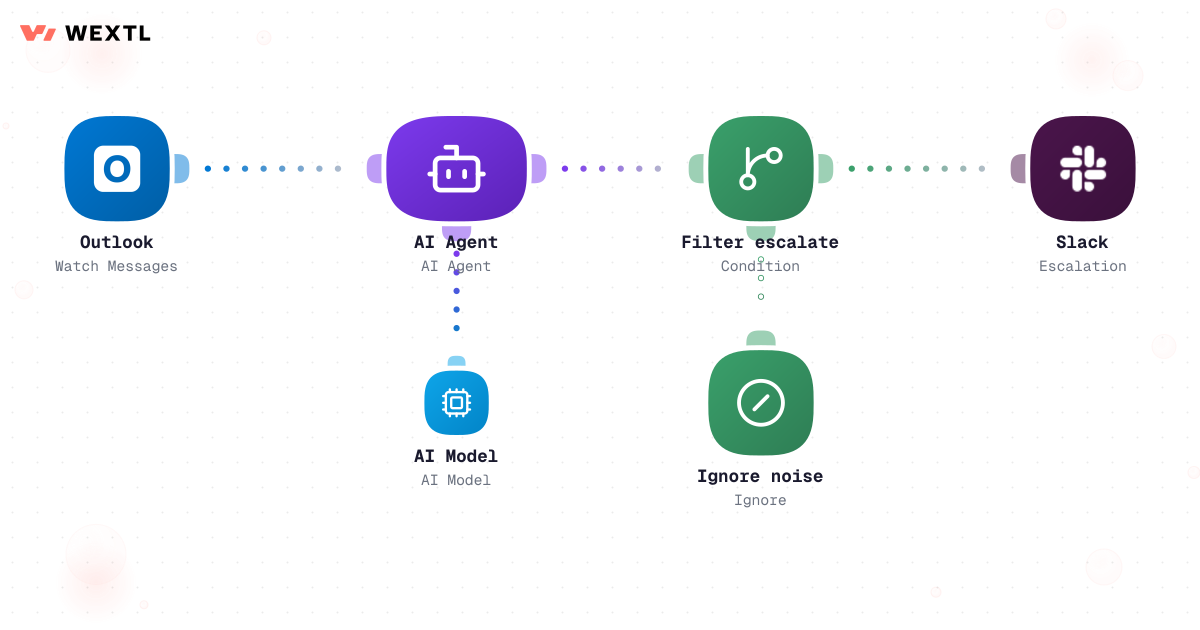
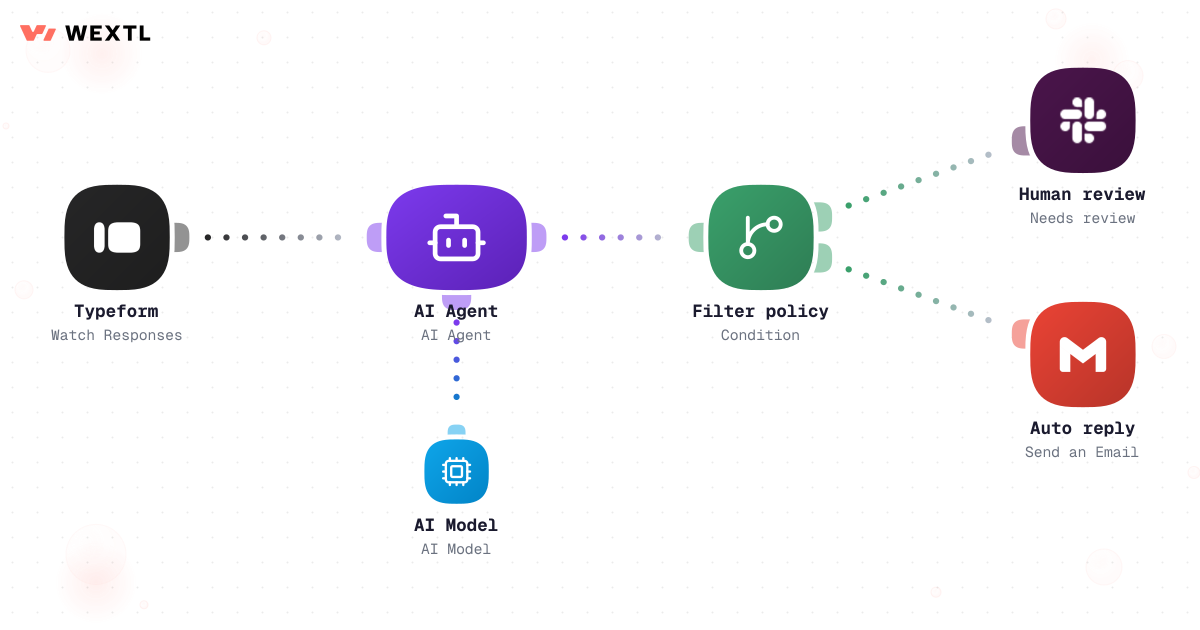
AI agent triaging Outlook messages with escalation branch
- GDPR
- Data Encryption
- 2FA
- Local Data Region
- 4
- agent patterns below, triage to guardrails
- 9
- logged steps in the triage example, start to log
- 3
- CRM, docs, and Slack tool calls behind one brief
* Illustrative example workflow shown on this page, not measured customer data.
AI agents automation, at a glance
Agent workflows with guardrails
Triage the inbox
Agent classifies mail, escalates priority items, ignores spam.
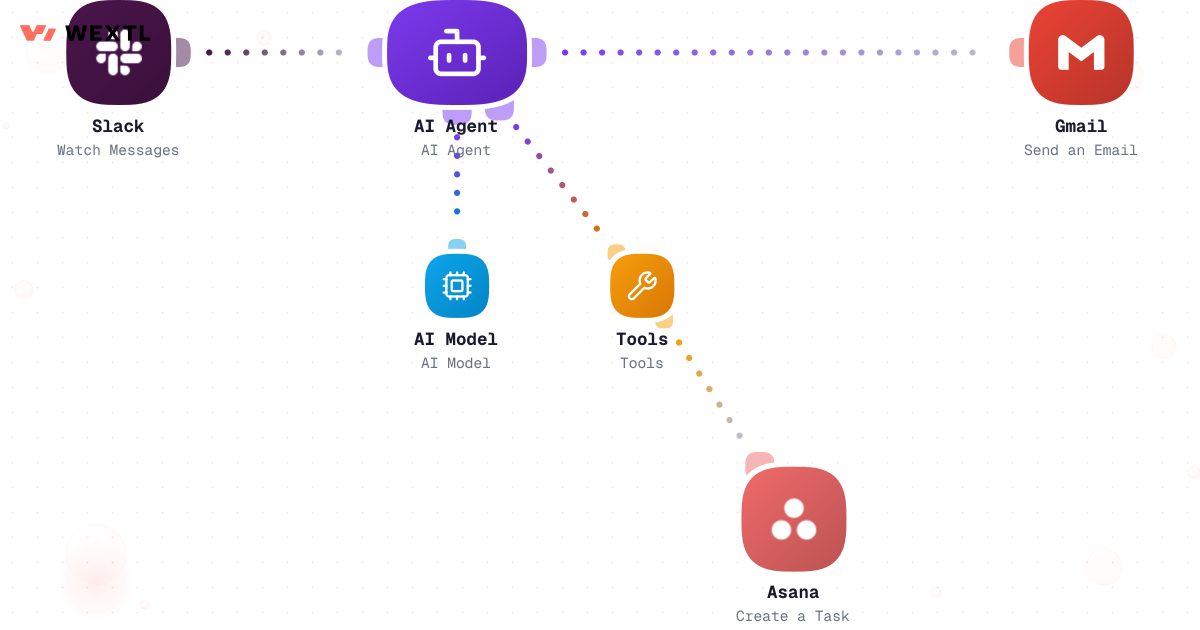
- Trigger — a new message arrives in a connected inbox or a Slack channel the agent monitors.
- Information collected — sender, subject or thread, prior labels on that sender, and any existing classification rules for that channel.
- Connected applications — Gmail or Microsoft Outlook for mail, Slack for escalation and the digest.
- Decision logic — classified against saved rules (ignore-list domains, VIP senders, keyword/topic match) into ignore, file, or escalate branches before the AI drafts anything.
- AI step — summarizes the thread and drafts a one-line reason for the classification so a reviewer doesn't have to reopen the source.
- Human approval — escalations post to Slack with the draft reasoning attached; nothing in the escalate branch auto-resolves itself.
- Actions — files routine mail, posts escalations with context, and ignores matched noise (logged, not silently deleted).
- Exception handling — a sender or topic the agent hasn't classified before routes to a manual-review queue instead of the agent inventing a new rule to fit it.
AI agent triaging Outlook messages with escalation branch
What actually happens when a chatbot can't touch your systems
A sidebar copilot summarizes the ticket, and someone still opens Zendesk and pastes the summary in by hand. A research question in Slack gets a confident paragraph back with no trace of which CRM record or doc it came from, so nobody can check it later without redoing the work. Someone finally says 'just let it send' — and the first wrong auto-reply is the last one before every agent in the company gets paused pending a review nobody scoped in advance.
- Step 1
Copy-paste is still the job
Chat answers the question; a human still opens the ticket and pastes the summary in.
- Step 2
No trace of what the model saw
A confident answer with no pointer back to the CRM record or doc it came from.
- Step 3
"Just let it send" becomes an incident
One wrong auto-reply and every agent gets paused for a review nobody scoped.
None of that is an AI problem. It's a missing audit trail and a missing approval gate.
Example: automate inbox-to-escalation triage with an agent
A concrete run, start to finish — the kind of triage agent a team clones from the template library and tunes to its own sender and topic rules.
Trigger: new mail or a Slack message hits the monitored inbox or channel.
The agent checks it against saved rules before it ever drafts anything — an ignore-list for known noise, a VIP list for priority senders, and a keyword/topic match for the rest.
Human judgment
An unfamiliar sender, a mixed-language thread, or anything the classifier scores below your confidence threshold gets forwarded whole to a human queue — the agent never invents a new rule to fit it.
1. Message arrives
— New mail or a Slack message hits the monitored inbox or channel.2. Classify against rules
— Sender, topic, and keyword rules run before the model touches it — known noise exits here, logged, not deleted.3. Draft the classification reason
— AI writes a one-line 'why' so a reviewer doesn't have to reopen the thread.4. Escalate and hold for review
— VIP and priority matches post to Slack with the draft reasoning attached; nothing in the escalate branch auto-resolves itself.5. File the rest
— Routine mail is filed and labeled without a human touching it.6. Log the run
— Every classification and tool call is recorded for later audit.
Example: automate a research brief before an agent acts
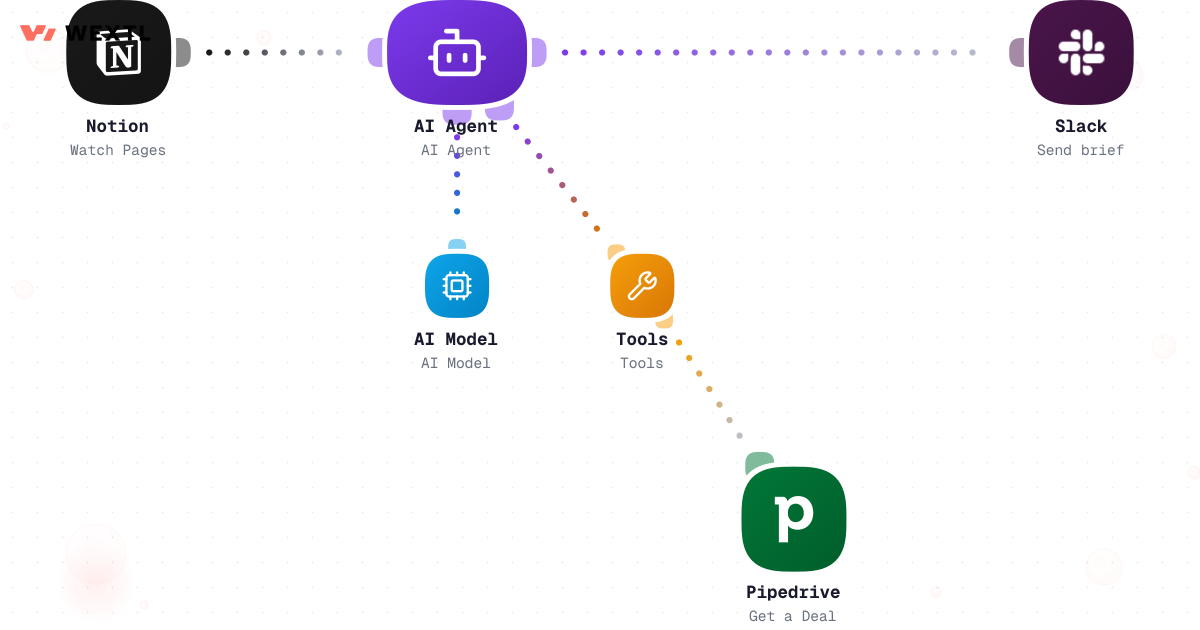
The same tool-calling logic, applied one step earlier: pull from the systems that actually have context, cite where each fact came from, and hand over only what's decision-ready.
Trigger: a Slack command or an upcoming meeting asks for a brief on an account.
Sources combined: the CRM record for deal stage and owner, linked docs, and the last several logged interactions.
Human judgment
The brief states what it found and what it couldn't find. Deciding whether a flagged gap needs a phone call before the meeting stays with the requester, not the agent.
WEXTL doesn't ship an autonomous agent that decides its own permissions — it ships an agent step on a canvas where the tools, the branches, and the audit log are yours to set.
What not to let an agent do unattended
Sensitive external replies, ticket closures on incomplete resolutions, and any write to a system of record are exactly where an agent should stop and hand back — not because the model can't attempt them, but because a wrong autonomous write costs more than a slower, reviewed one.
Where a human stays on
Anything that sends mail externally, closes a ticket, or writes to the CRM as a final answer — the agent drafts, flags, and proposes for these. It does not decide.
External replies stay draft-first
Auto-send is an opt-in switch per policy rule, not the default for any agent step.
Ticket closes need a confidence floor
Below the threshold, the agent hands off to a human instead of guessing it's resolved.
Nothing writes to a system of record silently
Every field an agent changes is in the run log, tied to the tool call that set it.
Who this page is for
Not every automation needs a tool-calling agent. This is for the specific moment a team decides an AI should be allowed to act, not just answer.
RevOps or Sales Ops leads
— Building a research agent that pulls CRM context before a rep opens a Slack thread.Support ops leads
— Piloting a triage agent to sort a shared inbox before it's assigned to a human queue.IT or platform engineers
— Evaluating whether an LLM agent can safely create tickets or touch internal systems.Security or compliance reviewers
— Who need a tool-call audit log before they'll approve any agent going into production.Founders and small ops teams
— Who are the whole department and want agent leverage without babysitting every reply.Anyone past the copilot pilot
— Replacing a chat-sidebar experiment with something actually allowed to act.
Connect the tools an agent is actually allowed to call
The model is one piece. What decides whether a pilot becomes production is which tools the agent can call, and whether every call gets logged.
These are the model providers and tool integrations agent workflows use most on WEXTL. An HTTP step reaches anything without a native connector, on the same allow-list.


From CRM context to a created ticket, one hop
A research agent that only summarizes still leaves someone to open the ticket tool and type it in by hand.
Chain the tool calls instead: the same run that reads the CRM record can hand its findings straight to a ticket-creation step — one workflow, one audit trail, no copy-paste in between.


