

Run workflows on your timetable
Run workflows on a timetable — morning digests, nightly reconciles, Monday briefs. WEXTL scheduling fires the same canvas as a webhook run, with every tick in run history.
- GDPR
- Data Encryption
- 2FA
- Local Data Region
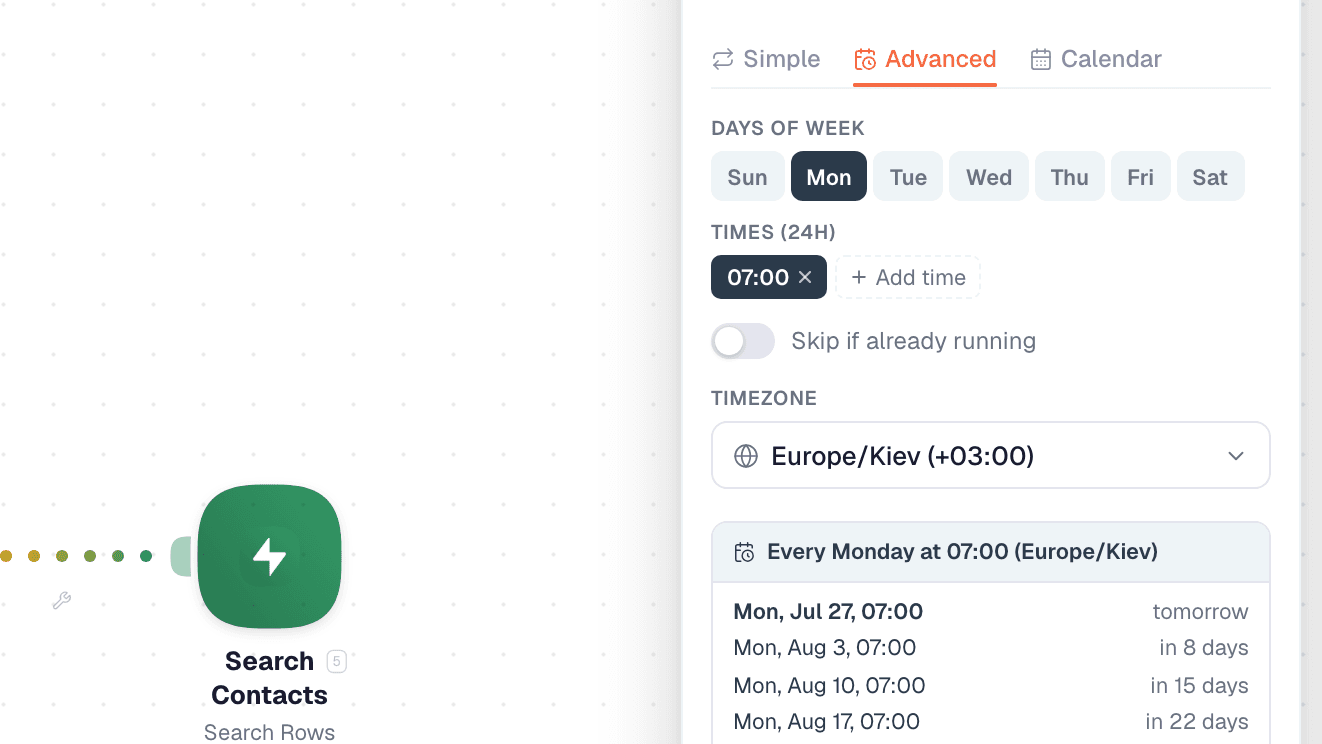
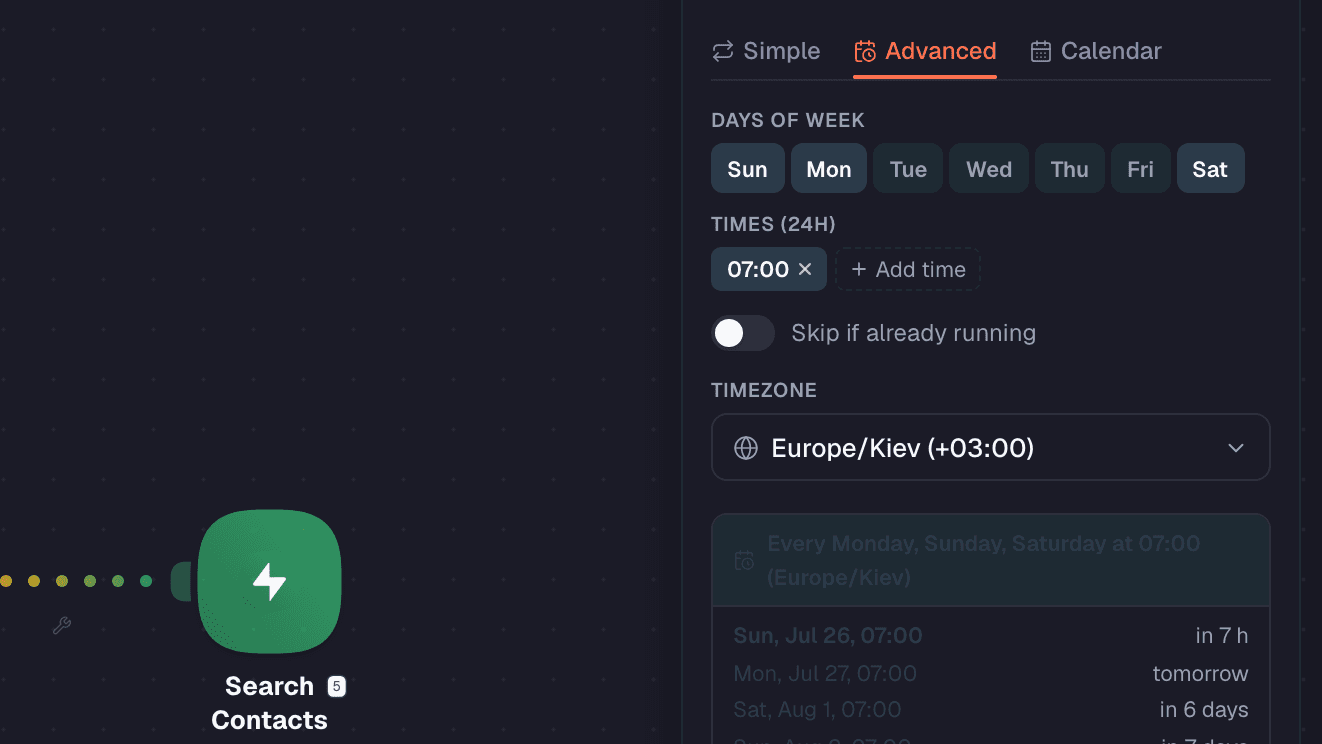
Schedule popover on the canvas — every Monday at 07:00
What Scheduling helps you do
Set the cadence, keep the canvas
- 1
Pick a cadence, set a timezone
Interval, weekly, monthly-by-day, monthly-by-nth-weekday, or last-day-of-month — each carries its own IANA timezone. No crontab syntax to get wrong.
- 2
Build the recurring work like any run
Refresh Power BI, pull rows from Sheets, notify Slack or Outlook — the schedule attaches to a trigger node; everything after it is the same canvas as a webhook or manual run.
- 3
Fires land on the clock; pause when needed
A 15-minute interval fires at :00, :15, :30, :45 local time, not 15 minutes after you last saved it. Toggle the workflow off to pause the whole cadence without deleting the schedule; turn on skip-if-running if an overlapping tick would fight over the same data.
Five cadence patterns, not a crontab
Interval fires every N minutes or hours, with an optional weekday restriction — a stock-level poll every 30 minutes, weekdays only. Weekly fires on the days and times you choose — Monday and Thursday at 09:00 for a biweekly ops digest.
Monthly-by-day fires on day numbers you pick — the 1st and 15th for a payroll-prep sync. Monthly-by-nth-weekday fires on an ordinal weekday, like the 2nd Tuesday for a board pack, or ordinal -1 for the last occurrence of that weekday. Last-day-of-month is its own pattern for a close routine, so nobody is computing whether this month ends on the 28th, 30th, or 31st.
Each pattern carries its own IANA timezone set on the schedule itself — a US finance close and an EU morning digest can sit in the same workspace, each firing on its own local clock.
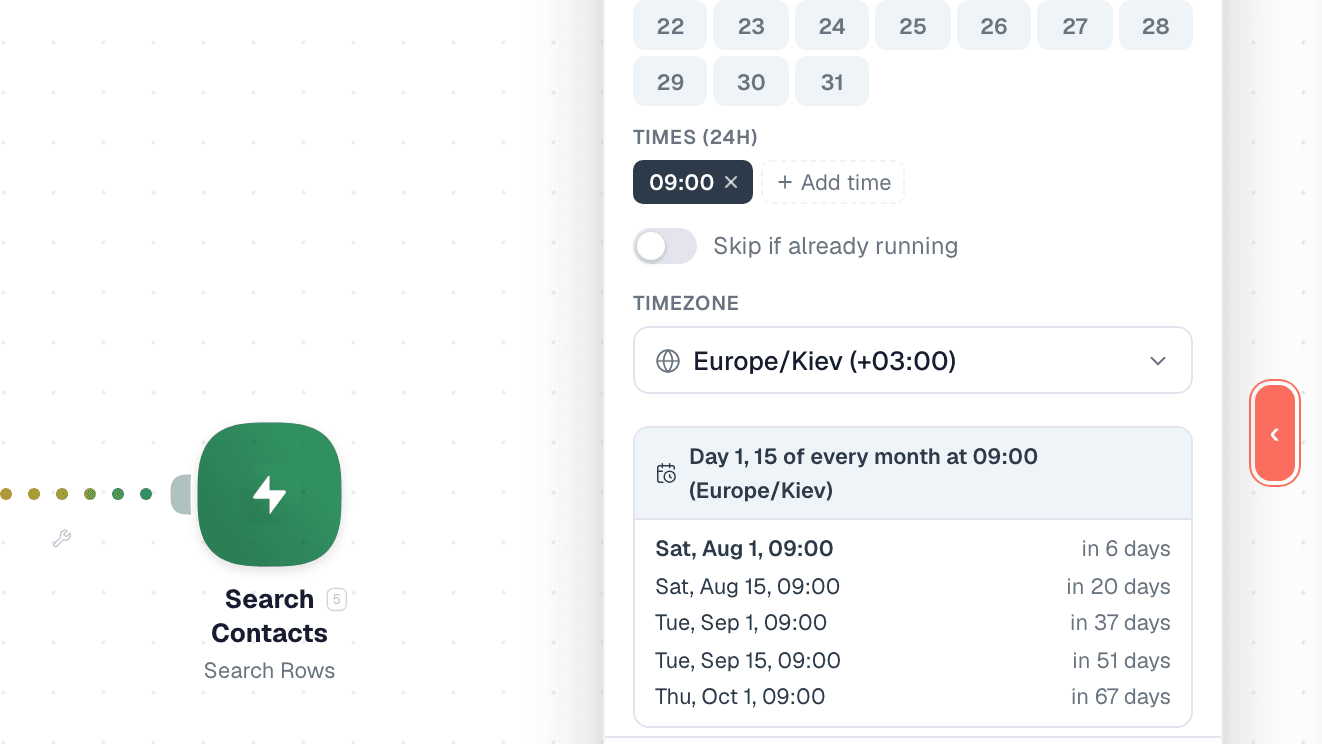
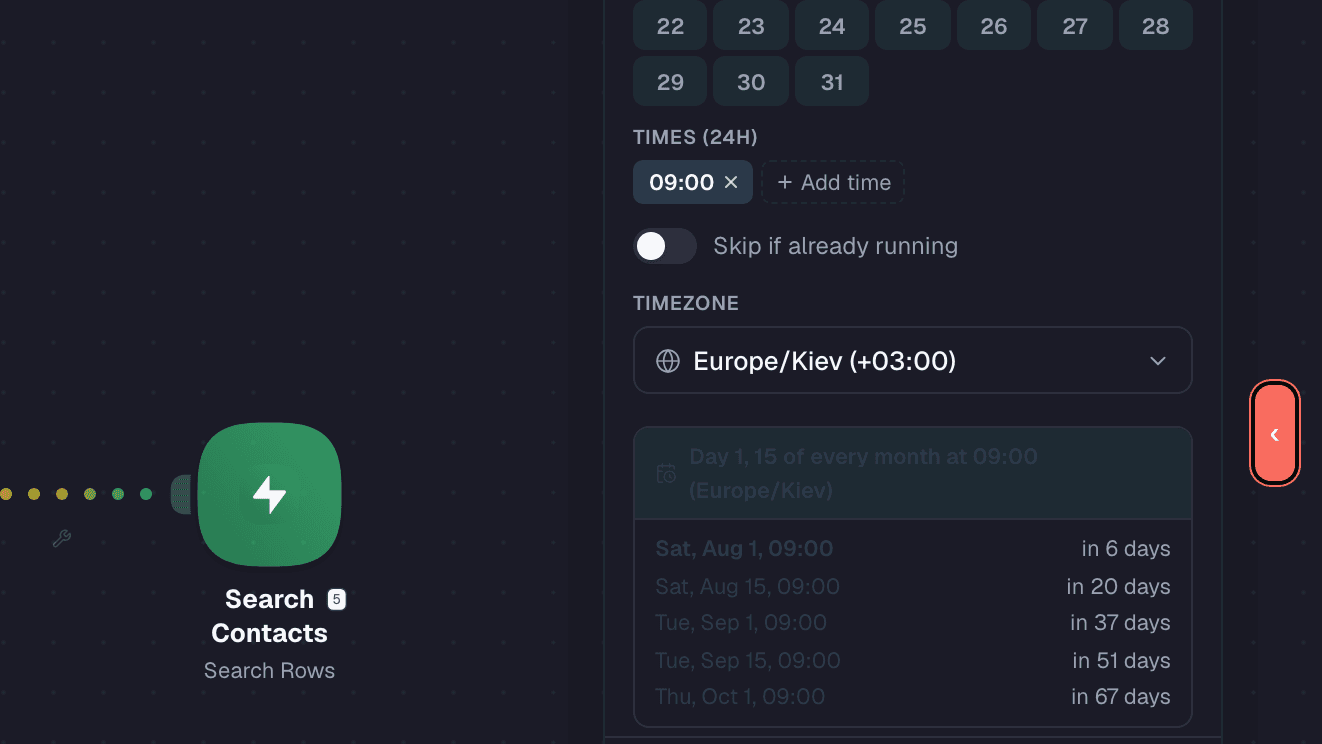
Calendar cadence — day 1 and 15 of every month at 09:00
Fires land on the clock, not on drift
An interval set to every 15 minutes fires at :00, :15, :30, and :45 in the schedule's local time — wall-clock-boundary alignment, the way traditional cron aligns — not 15 minutes after whoever last saved the workflow. Two schedules set to the same interval land on the same clock ticks.
Daylight saving time is handled explicitly, not left to chance: a time that falls inside a spring-forward gap rolls forward to the first valid instant after the jump; a time that falls in the fall-back fold — which occurs twice — fires once, on the earlier occurrence, never twice.
By default, a schedule that fires while the previous tick is still running just enqueues the new run — the same stack-and-run behavior most automation tools default to, no silent coalescing and no dropped tick. Turn on skip-if-running for a specific schedule and WEXTL suppresses that overlapping fire instead — useful for a CRM reconcile that occasionally runs long, where two overlapping diffs would fight over the same rows; the schedule still advances to its next slot rather than piling up a backlog of missed runs to replay.
Turning a scheduled workflow off stops the cadence without touching the graph — useful for a freeze window during month-end close, where the workflow needs to stay intact but silent. Editing the cadence afterward — moving a digest from daily to weekdays-only, or a close routine from the 30th to last-day-of-month — recomputes only the next fire time; the nodes, apps, and logic downstream of the trigger don't get rebuilt.
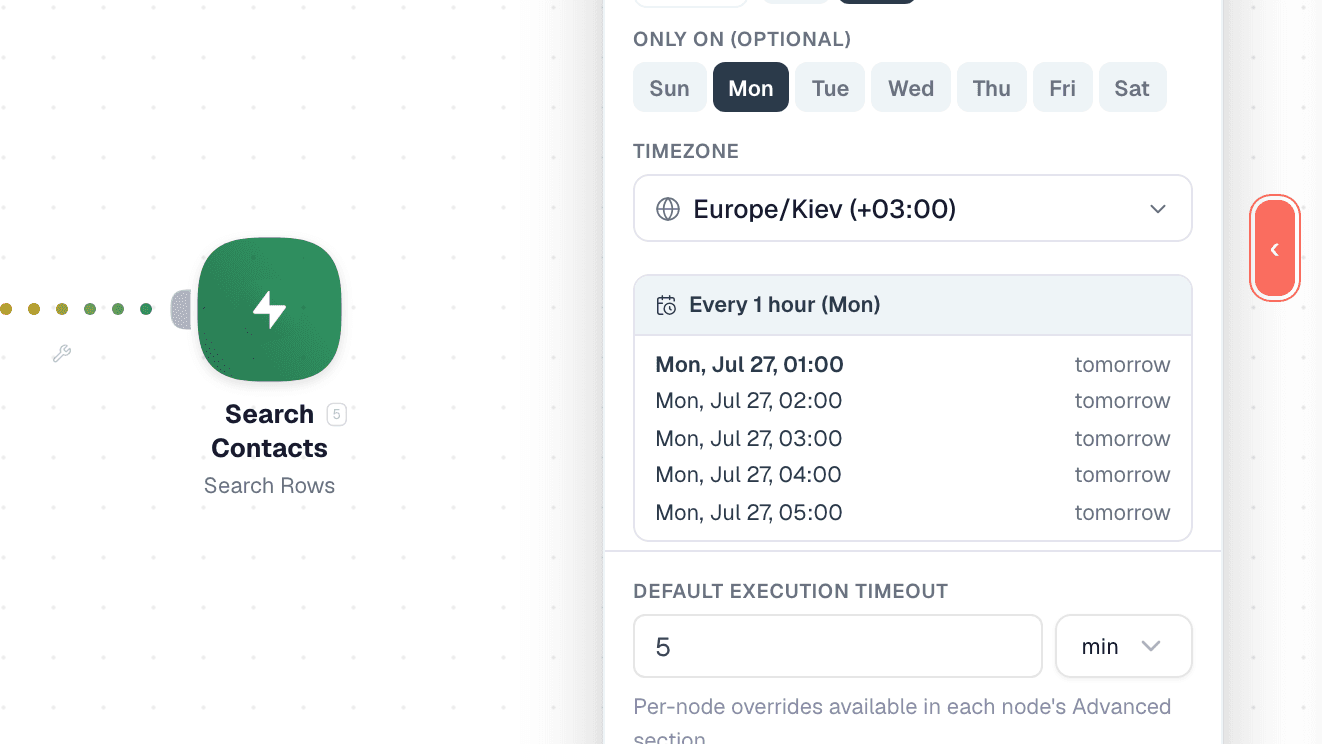
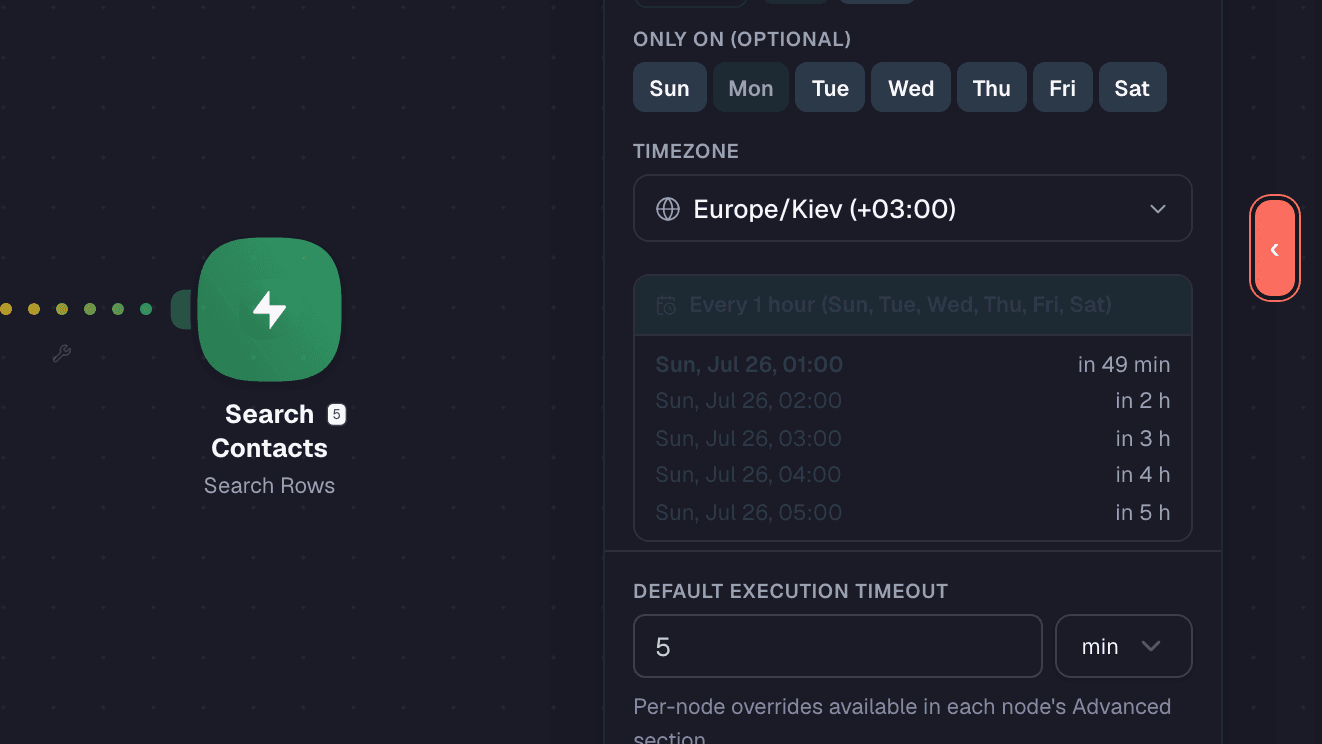
Simple cadence — every hour, Mondays only