


Start a workflow from any event
Start a workflow the moment another system fires an event. WEXTL gives you an inbound webhook URL, payload filters, and the rest of the canvas for CRM, Slack, tickets, and JS Code.
- GDPR
- Data Encryption
- 2FA
- Local Data Region
HTTP webhook watch filtering a payload into Pipedrive and Airtable
What Webhooks helps you do
POST in, routed work out
- 1
Mint a webhook URL
Add a Webhook trigger and get a POST URL — paste it into Stripe, Typeform, GitHub, or any vendor's webhook settings; nothing else needs deploying.
- 2
Verify, then filter
Check the sender first (signature header or shared token in a Filter/JS Code step), then drop heartbeats and fields you don't need — unverified or noisy events exit on Ignore.
- 3
Fan out on the canvas
Update Pipedrive, ping Slack, open BoldDesk — one run, one run id, every step's input and output logged.
Bridge vendor webhooks into your stack
Stripe sends a charge object, Typeform sends a form_response, GitHub sends a push payload — three different shapes hitting the same kind of URL. Point each vendor's webhook settings at a WEXTL Webhook trigger, and a Filter node right after it reads the fields that differ per vendor to decide CRM vs warehouse vs ignore — every POST becomes a run you can actually open, not a fire-and-forget endpoint.
A webhook URL is public the moment you paste it into a vendor's dashboard — anyone who has it, or guesses it, can POST to it. Put a Filter or JS Code step right after the trigger to check the vendor's signature header (Stripe-Signature, GitHub's X-Hub-Signature-256) or a shared secret token against a value in Credentials, and branch requests that fail the check to Ignore before they ever reach Pipedrive, Slack, or a billing action.
When a vendor ships a new API version and renames a field, you see the mismatch on that specific run's payload — not as a silent drop in a queue you never open.
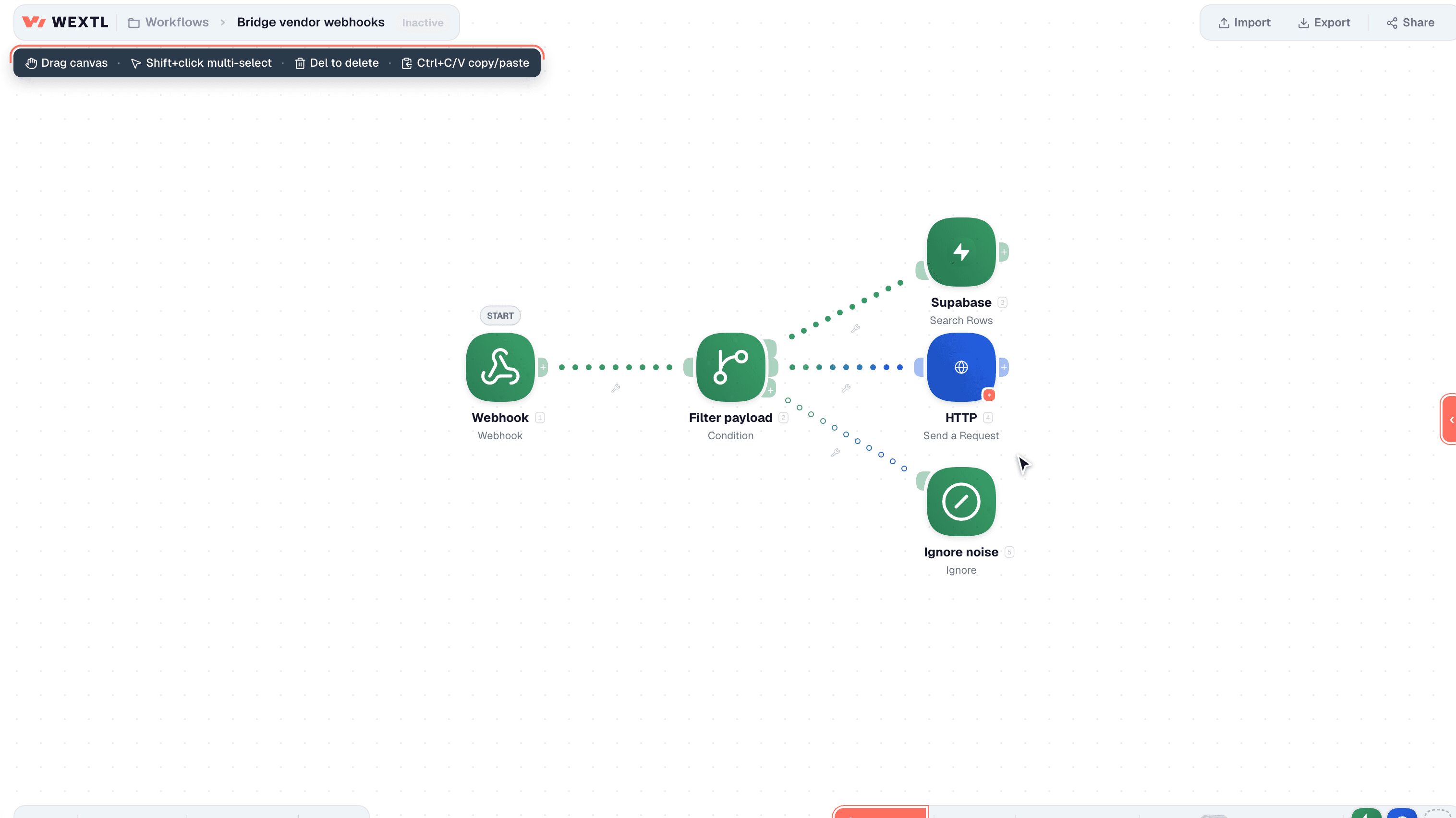

Webhook intake filtering into CRM and warehouse paths
Filter once, fan out to apps
One verified inbound event can create a CRM person in Pipedrive, notify a Slack channel, and open a BoldDesk ticket in the same run — same run id across all three, so a support agent debugging a missing ticket can trace it back to the exact POST that triggered it.
Vendors like Stripe and GitHub retry a webhook delivery if your endpoint doesn't answer fast, and some resend the same event id on an ambiguous timeout. The inbound route acknowledges the request and returns before the rest of your canvas runs, so a slow downstream app node never turns into a vendor retry storm — and each webhook has its own rate-limit bucket, so one noisy sender can't starve the others in your workspace.
If a vendor does resend the same event, add a Filter or Database node lookup keyed on its event id before you create a CRM record, so a duplicate delivery doesn't create a duplicate contact — the same Filter pattern that sends a Stripe invoice.updated with no balance change, a GitHub ping event, or a Typeform partial_submission to Ignore instead of Slack.
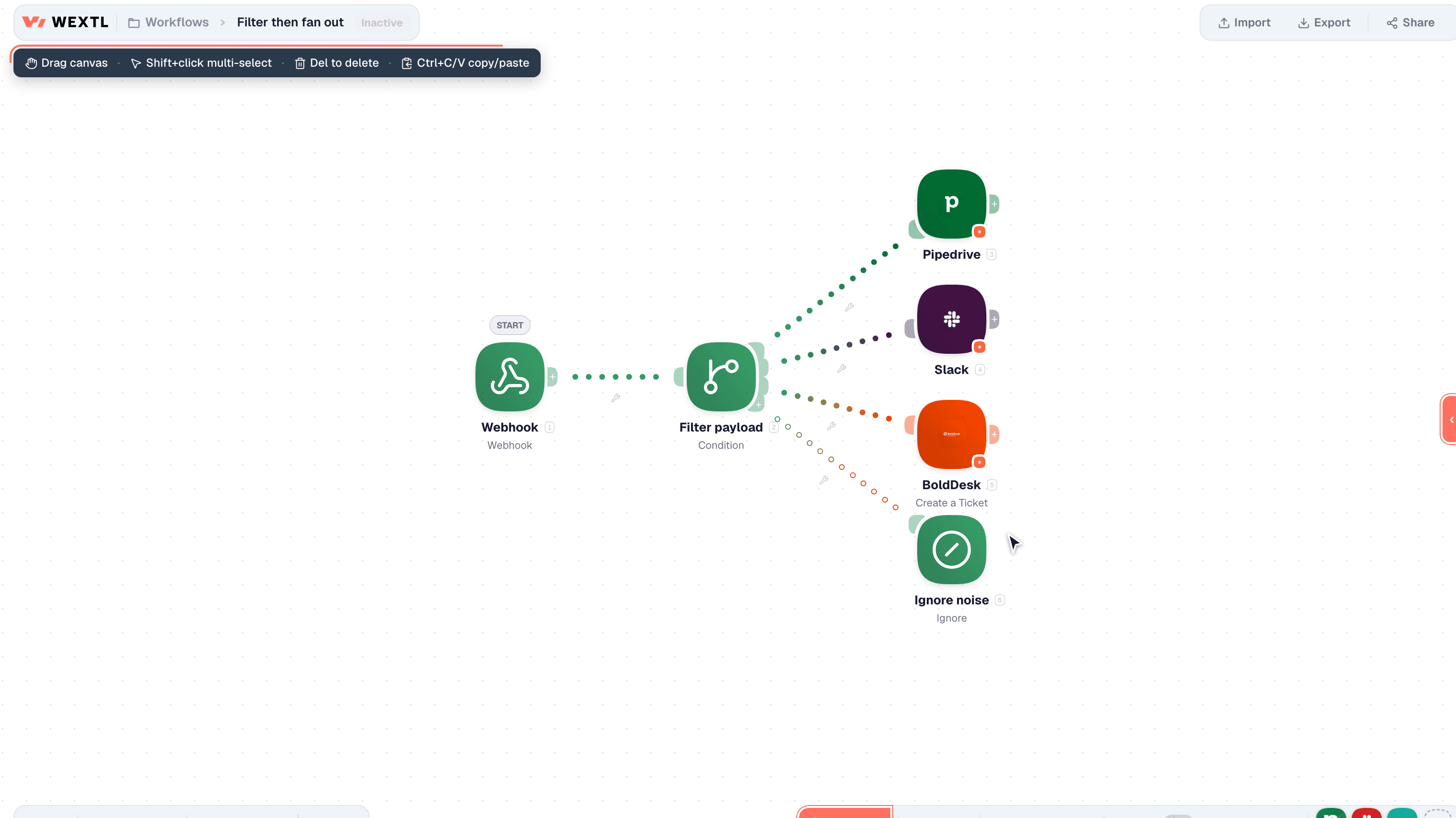
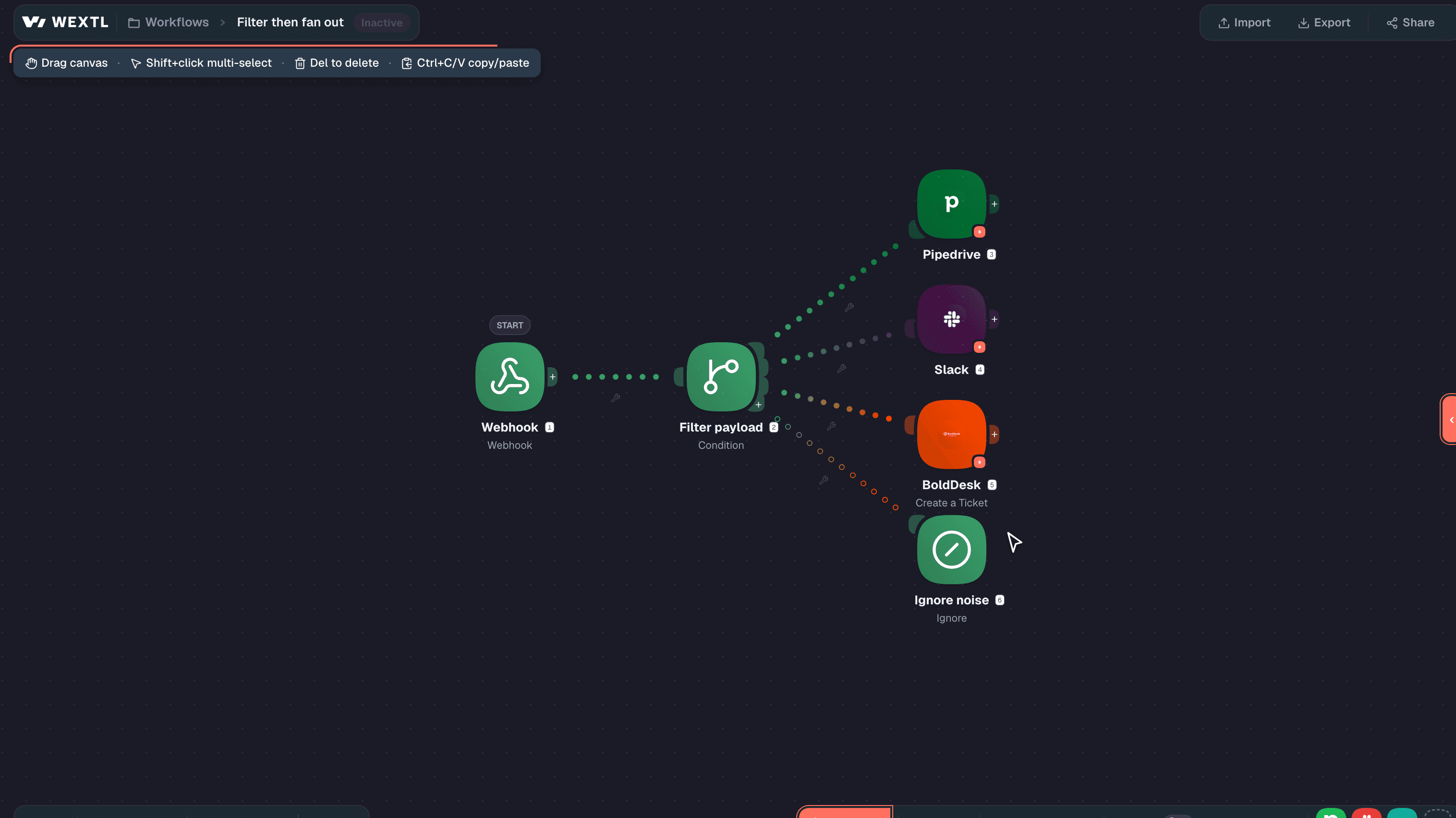
Webhook trigger filtering into Pipedrive, Slack, BoldDesk, or ignore


