


People processes that run themselves
Onboarding, offboarding, approvals, pulse surveys — the work matters, the chasing does not. Design the process once and WEXTL runs it the same way every time, with a log to prove it.
Deploys this workflow into your workspace — you'll connect your own accounts.
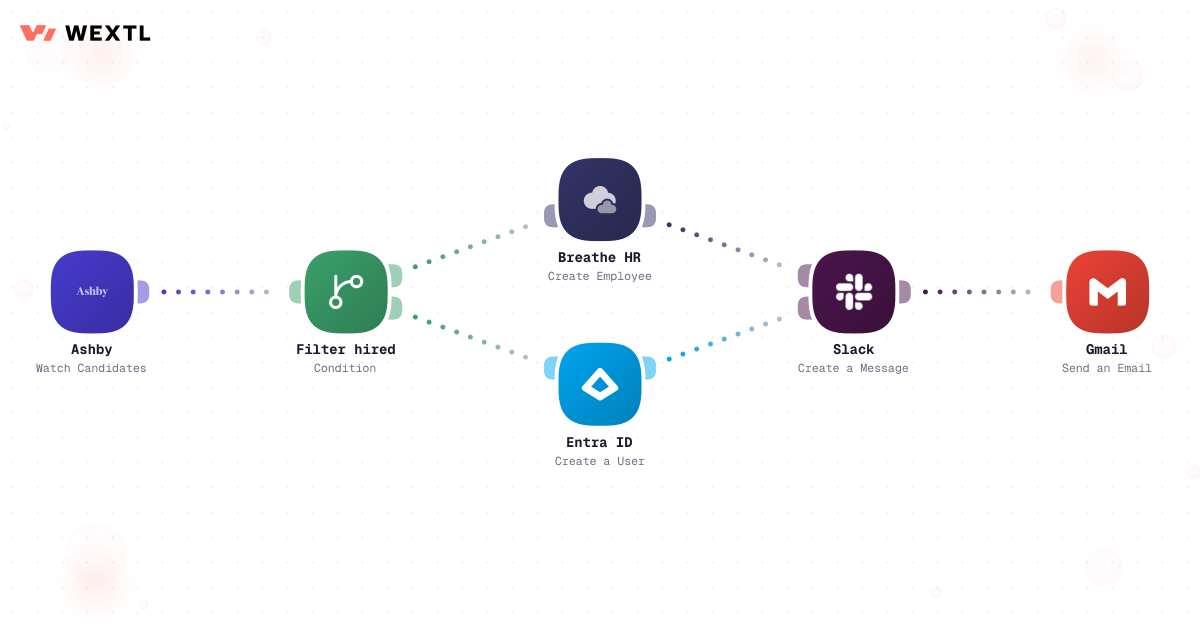
Workflow that loops through onboarding checklist items and completes each one in order
- GDPR
- Data Encryption
- 2FA
- Local Data Region
- 4
- systems one promotion touches by hand
- Same day
- access revoked once status changes to terminated
- 1
- HRIS org chart approvals read, not a spreadsheet
* Illustrative example, not measured customer data.
HR automation, at a glance
What HR teams build with WEXTL
Four patterns most HR teams start with. Clone a template, swap in your tools, and adjust the steps to match your process.
Day one, already done
One workflow watches for signed offers and works through your entire checklist — accounts, groups, equipment, welcome email — in order.
- Trigger — an offer is marked signed in the ATS (Lever) or the signed offer letter comes back through the e-sign tool (PandaDoc).
- Information collected — start date, employment type (full-time, part-time, contractor), department, work location/country, and reporting manager.
- Connected applications — Lever or PandaDoc for the signed offer, your HRIS (Personio, CharlieHR, Breathe HR, or similar) for the employee record, Microsoft Entra ID for account provisioning, Slack for the manager notification.
- Decision logic — employment type and country branch the checklist: a contractor skips benefits enrollment, a different work location swaps in the matching compliance documents, a remote hire gets equipment shipped instead of a badge request.
- AI step — drafts the personalized welcome message and pre-fills the HRIS profile from the offer-letter fields instead of retyping them by hand.
- Human approval — HR reviews the auto-filled HRIS profile, especially compensation and start-date fields, before it's marked active.
- Actions — creates the HRIS record, provisions the access the role needs, sends the welcome message, and opens a day-one checklist task for the manager.
- Exception handling — a missing work-authorization field halts account provisioning and flags HR instead of guessing at start-date eligibility.
Workflow that loops through onboarding checklist items and completes each one in order
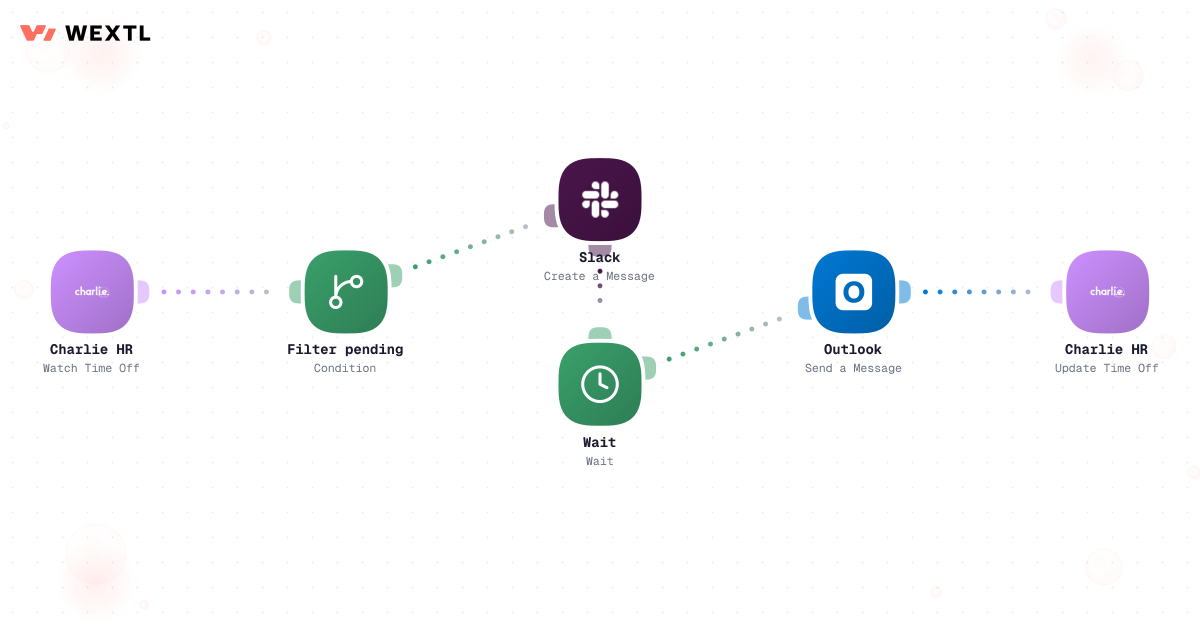
What an HR generalist actually spends a day fighting
None of it is hard. A promotion is one change — new title, new pay band, new reporting line — and yet it has to be typed into the HRIS, then payroll, then the directory, then benefits, each in a slightly different format. An approval sits in a manager's inbox because nothing nudges it after three days. A termination lands on a Friday afternoon and access has to be gone everywhere by end of day, coordinated by email between HR, IT, and security.
- Step 1
The same change, retyped four times
HRIS, payroll, the directory, and benefits each need the update separately.
- Step 2
An approval nobody escalates
A leave or comp request sits in an inbox until someone remembers to chase it.
- Step 3
A same-day access deadline
Termination access removal coordinated by email across HR, IT, and security.
WEXTL is not trying to replace HR's judgment — it handles the repetitive record-keeping and routing so HR can spend more time on the people decisions that actually need a person.
Example: automate new-hire onboarding
A concrete run, start to finish — the onboarding workflow an HR generalist clones from the template library and adjusts to the company's own checklist.
Trigger: the offer is marked signed in the ATS, or the signed offer letter comes back through the e-sign tool.
WEXTL checks: employment type, work location and country, start date, department, and manager — then branches the rest of the checklist off those fields.
Human judgment
Compensation and start-date fields always wait for a human check. A missing work-authorization field halts provisioning and routes to HR instead of guessing at eligibility.
Example: automate a compensation-change approval chain
The same logic, applied to approvals: route on the org chart that already exists, not a manually maintained spreadsheet of who reports to whom.
Trigger: a manager submits a raise or promotion request through the HRIS self-serve form.
WEXTL checks: the requested amount against the role's comp band, the employee's current manager from the org chart, and whether the amount clears the threshold that requires a second approver.
Human judgment
No comp change is ever auto-approved. An amount outside the band, or a request missing a configured second approver, routes back to HR instead of moving forward on a guess.
What HR should not automate blindly
Termination timing, disciplinary communications, compensation decisions, and anything touching protected employee data are exactly where automation should stop and hand back to a person — not because the tooling can't attempt them, but because getting them wrong carries legal and human cost that a slow, correct decision doesn't.
Where a human stays on
Anything affecting pay, employment status, or a disciplinary record gets drafted and routed — never decided — by the workflow.
Termination timing stays a decision
The workflow executes the revocation; a person decides when it's appropriate to trigger it.
PII stays out of chat channels
Sensitive fields write to the HRIS record; Slack gets a status, not the packet.
Comp and disciplinary calls stay human
AI drafts context; it never decides an amount or a consequence.
Who HR process automation is for
Not every HR role needs this on day one. It's built for the parts of the job that repeat across a lot of hires, a lot of approvals, or a lot of systems that don't talk to each other.
HR generalists running onboarding solo
— One person doing the checklist that touches five systems for every hire.People Ops managing multi-country teams
— Different compliance documents and benefits rules by country, applied consistently.HR coordinators buried in approvals
— Leave, comp, and policy-exception requests that need routing, not just a form.HRIS or systems admins
— Keeping the HRIS, payroll, and directory in sync after every change.Teams handling frequent offboarding
— Access revocation that has to be exact on the effective date, every time.People teams running regular pulse checks
— The same survey-to-summary process, on a schedule, without a manual rollup.


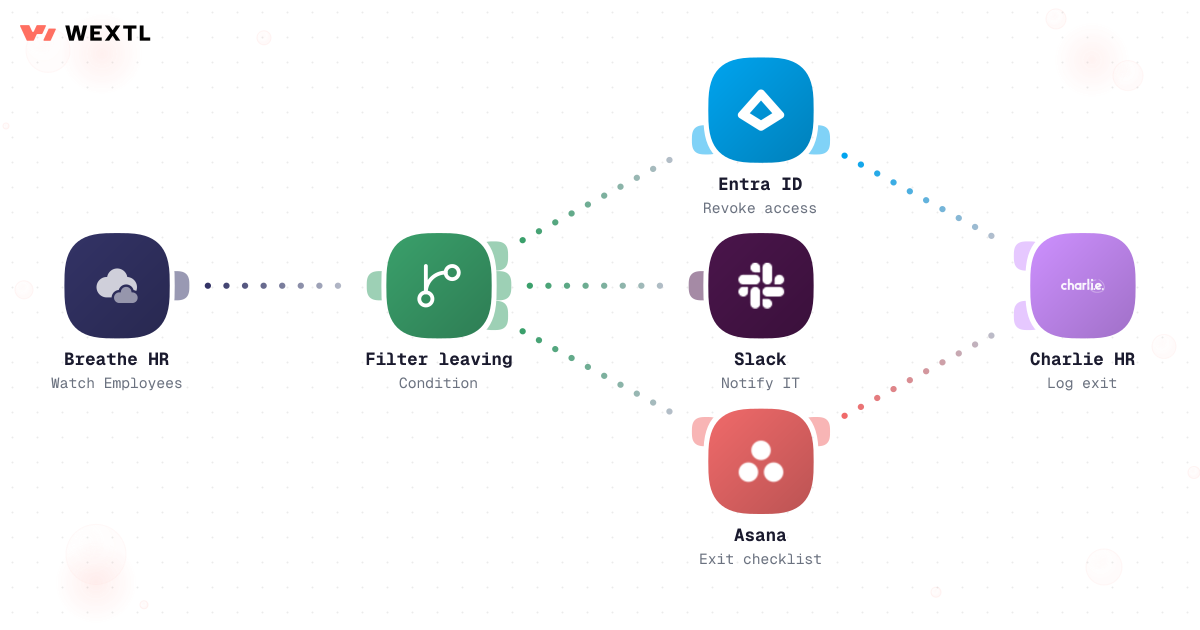
Access revoked the same day, not the same week
Offboarding is a security deadline, not a task someone gets to eventually.
When the HRIS marks an employee terminated, the workflow revokes access at the effective moment and logs exactly what was removed and when.
- Step 1
Effective-date accuracy
Access is removed at the configured moment, not the next time someone checks.
- Step 2
Legal-hold exception
A flagged account skips automatic revocation and routes to HR instead.
- Step 3
Full revocation log
Every system checked and every access removed is recorded per run.
Connect the tools HR already runs on
You don't get to pick a new HRIS just to automate around it. The HRIS, payroll, and ATS already in place are what has to be met where they are.
These are the integrations most HR workflows actually use. An HTTP step reaches anything else with an API.
- PersonioHRIS record, org chart, and comp-band data that drives approval routing.
- CharlieHREmployee records and onboarding checklists for smaller HR teams.
- Breathe HREmployment-status changes that trigger offboarding and access revocation.
- RipplingCombined HRIS and payroll sync so a record change reaches pay in one run.
- GustoPayroll updates for comp changes and new-hire pay setup.
- PaychexPayroll sync for teams already standardized on Paychex.
- LeverOffer-signed events that kick off onboarding without a manual handoff from recruiting.


