


Day one, ready before they arrive
Whether it's a new customer or a new hire, the first week is a checklist of small tasks that always slip. Put the checklist in a workflow and day one takes care of itself — accounts created, invites sent, owners notified.
Deploys this workflow into your workspace — you'll connect your own accounts.
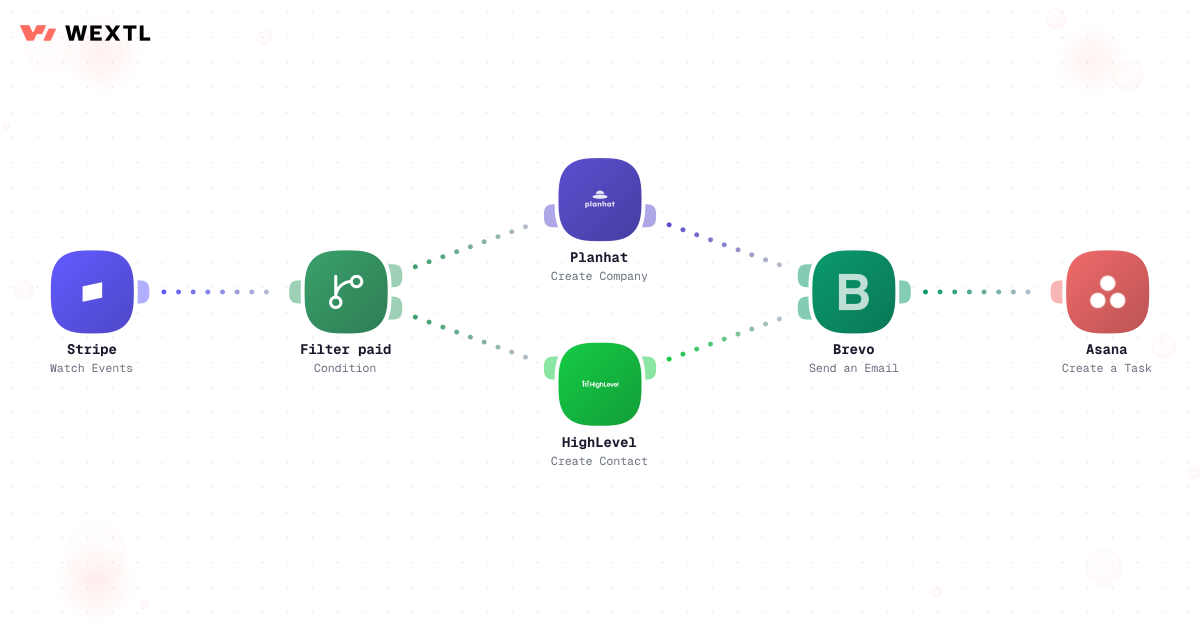
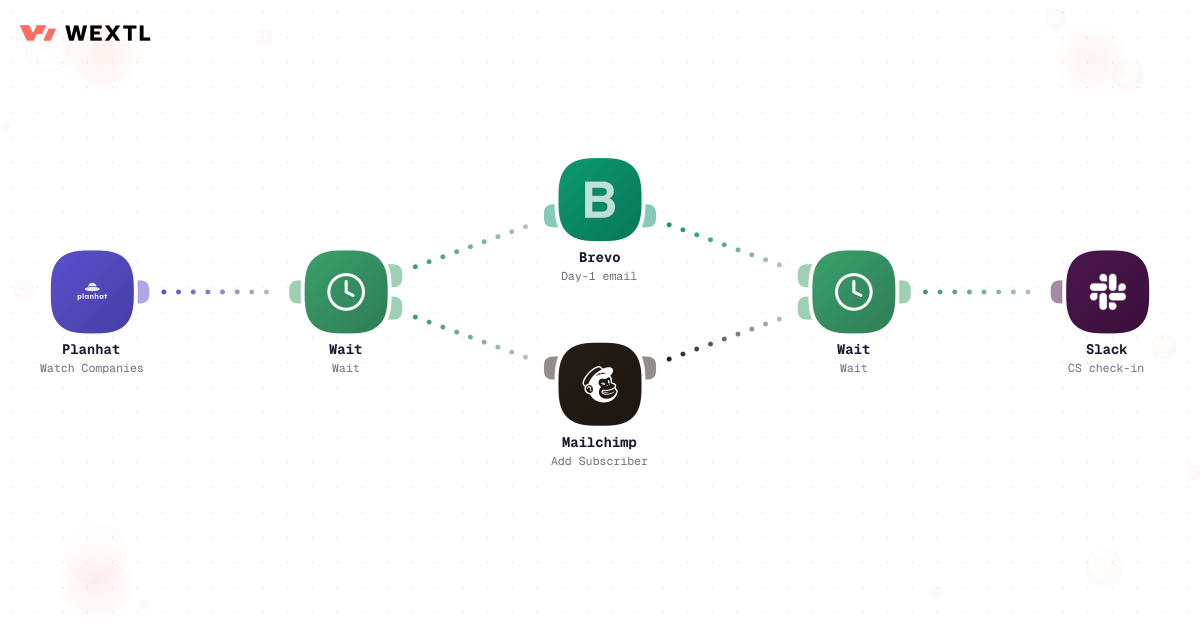
Workflow that loops over new customer records and creates accounts and welcome tasks for each
- GDPR
- Data Encryption
- 2FA
- Local Data Region
- 3
- days of silence before a stalled account is nudged
- 2
- business days to a scheduled enterprise kickoff
- 4
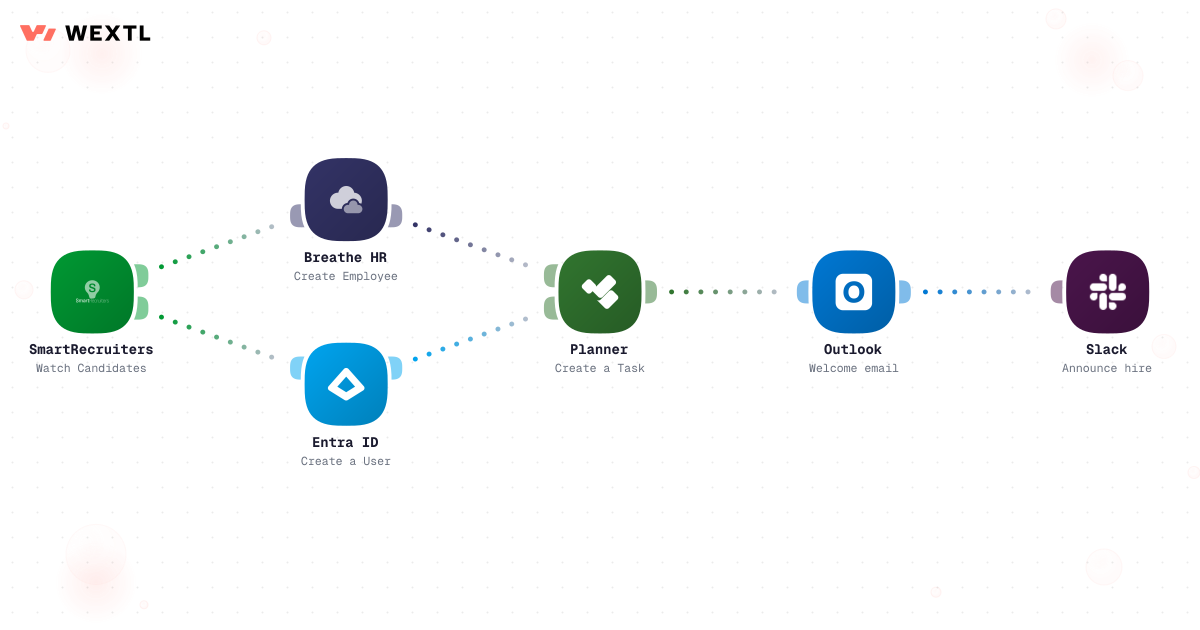
- systems per hire — ATS, HRIS, directory, chat
* Illustrative example, not measured customer data.
Onboarding automation, at a glance
One workflow for the whole first week
Customer or employee, the shape is the same: a trigger, a checklist of steps, and a clear record of what ran.
From signed to set up, same day
The deal closes and the workflow takes over: workspace provisioned, kickoff scheduled, welcome sequence started.
- Trigger — a deal is marked closed-won in the CRM, or the contract shows fully executed after the last signature.
- Information collected — plan tier, contract value, primary and technical contacts, and the implementation notes from the sales handoff.
- Connected applications — Salesforce for the deal record, PandaDoc for the signed contract, Planhat for the CS workspace, Stripe for billing.
- Decision logic — branches on plan tier (self-serve accounts skip the kickoff call; enterprise accounts get one scheduled within 2 business days) and on whether a technical contact is on the contract — if none, the run holds for CS to request one.
- AI step — drafts the kickoff email and pre-fills the CS handoff brief from the deal's notes and call transcripts.
- Human approval — the assigned CSM confirms the kickoff date and reviews the brief before it reaches the customer.
- Actions — creates the account in the CS platform, schedules the kickoff, generates the first invoice, and posts the handoff to the CS team channel.
- Exception handling — a contract signed without a payment method on file holds the invoice and flags billing instead of invoicing a guess.
Workflow that loops over new customer records and creates accounts and welcome tasks for each
What onboarding actually looks like without a workflow
None of it is hard. A new hire's directory account gets created a day late because the ticket sat in a queue. A signed contract sits in an inbox for two days before anyone tells Customer Success it closed. A welcome sequence sends the same day-one email to everyone, whether they finished setup or haven't logged in once.
- Step 1
The access gap
A start date arrives before the directory account does.
- Step 2
The blind handoff
Sales closes the deal; CS finds out from a forwarded email, or doesn't.
- Step 3
One sequence, every audience
Setup-guide reminders sent to people who finished setup last week.
None of it needs a judgment call. All of it depends on someone remembering — until it doesn't.
Example: automate new-hire provisioning
A concrete run, start to finish — the kind of provisioning workflow an HR or IT team clones from the template library and adjusts to their own access tiers.
Trigger: an offer is marked accepted in the ATS, or a start date is confirmed in the HRIS.
WEXTL checks: department and role (to pick the right access set), employment type — full-time vs. contractor — work location, and whether a manager is assigned on the record.
Human judgment
A start date that moves, a missing manager assignment, or any request for admin-level access routes to a person instead of provisioning against a guess. The workflow assembles the access; IT decides the exceptions.
- Step 1
1. Offer accepted
The ATS record flips to accepted and starts the run.
- Step 2
2. Pull the hire's details
Reads department, role, manager, start date, and location from the HRIS record.
- Step 3
3. Match the access set and check employment type
Engineering gets repo and staging access, finance gets ERP access — mapped by department and role — and contractors get scoped, time-limited access instead of the standard full-time set.
- Step 4
4. Draft the welcome message
AI personalizes it with the manager's name, team, and first-week schedule.
- Step 5
5. Hold for IT approval
Any request touching finance systems or admin-level groups waits for a human sign-off.
- Step 6
6. Provision the accounts and log every step
Creates the directory account, assigns groups, adds the new hire to the right Slack channels, and records each action against the hire's record for the audit trail.
Example: automate customer onboarding kickoff
The same logic, applied to a signed deal: get the account ready and the kickoff scheduled before the champion has to ask what happens next.
Trigger: a deal is marked closed-won in the CRM, or the contract shows fully executed after the last signature.
WEXTL checks: plan tier, contract value, whether a technical contact is on file, and whether a payment method is attached to the account.
Human judgment
A contract signed without a payment method holds the invoice and flags billing instead of invoicing a guess. A strategic account's contract terms stay a CSM's call, not the workflow's.
Who onboarding automation is for
Not every team needs this on day one. It's built for the parts of onboarding that repeat across a lot of hires, a lot of signed deals, or a lot of systems that don't talk to each other.
HR and People Ops coordinators
— Running the same new-hire checklist across every department and location.IT admins provisioning access
— Directory accounts, groups, and equipment for every new starter, not just the ones someone remembers to ticket.Customer Success Managers
— Kicking off every signed deal on a consistent cadence instead of whenever the handoff email surfaces.RevOps and Sales Ops
— Owning the contract-to-cash handoff between the CRM, e-signature, and billing tool.Office managers coordinating day-one logistics
— Badges, desks, and equipment ready before someone walks in.Teams onboarding in batches
— Seasonal or intern cohorts where a few minutes per hire adds up to days of manual work.
WEXTL is not trying to replace HR, IT, or Customer Success — it handles the provisioning and scheduling mechanics so the people who own onboarding can spend their time on the parts that need a person.
Paperwork that reaches payroll on its own
Onboarding paperwork — I-9, tax forms, direct deposit — usually means a new hire fills something out and someone else re-keys it into payroll days later.
Completed onboarding forms flow straight into payroll setup the moment they're signed, so the first pay cycle isn't a scramble.


From signed contract to first invoice, same day
A signed contract sitting in an inbox for two days is a slow start with a customer who just committed.
The moment the last signature lands, the account and the first invoice exist — no handoff email to finance required.
- Step 1
Signature completes the contract
The e-signature event is the trigger, not a status someone updates by hand.
- Step 2
Invoice created same day
The first invoice generates with the numbers already on the signed contract.
- Step 3
Finance sees it immediately
No forwarded email — the invoice exists in the finance tool the moment the contract closes.
Connect the systems onboarding actually runs through
You don't get to pick a clean slate. The ATS, HRIS, CRM, and e-signature tool are already fixed — whatever you automate has to meet them where they are.
These are the integrations most onboarding workflows actually use. An HTTP step reaches anything else with an API.


