


Your campaigns run. Your reports write themselves.
Connect the tools your team already uses and let WEXTL handle the busywork between them. Leads land in the CRM with attribution, reports post on schedule, and nobody rebuilds a spreadsheet on Monday.
Deploys this workflow into your workspace — you'll connect your own accounts.
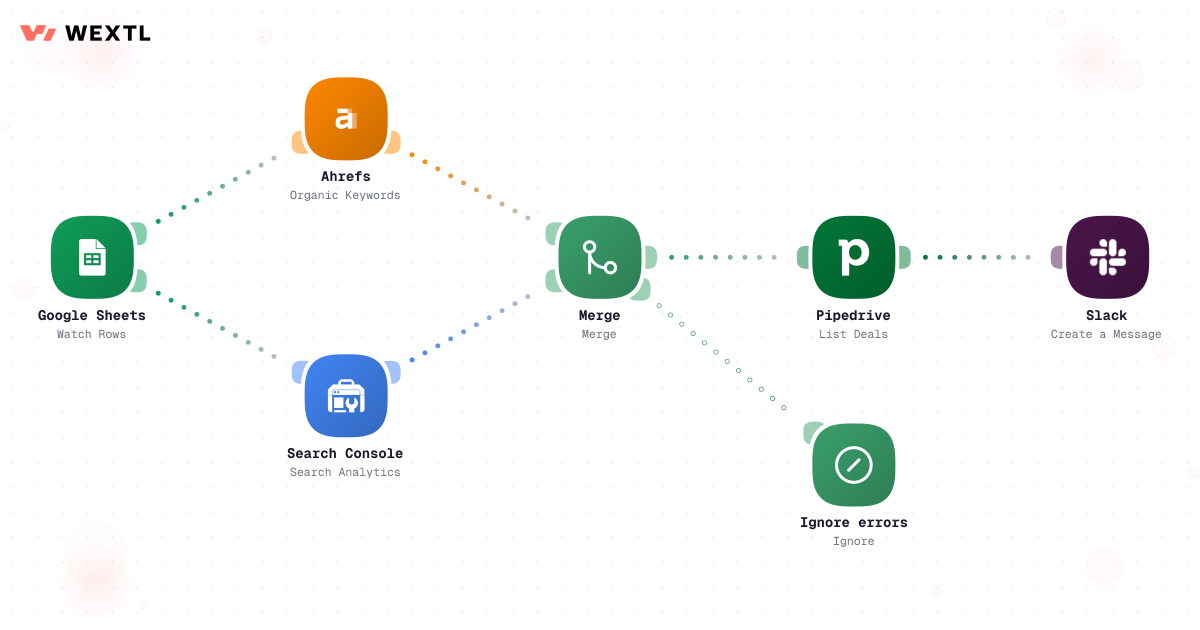
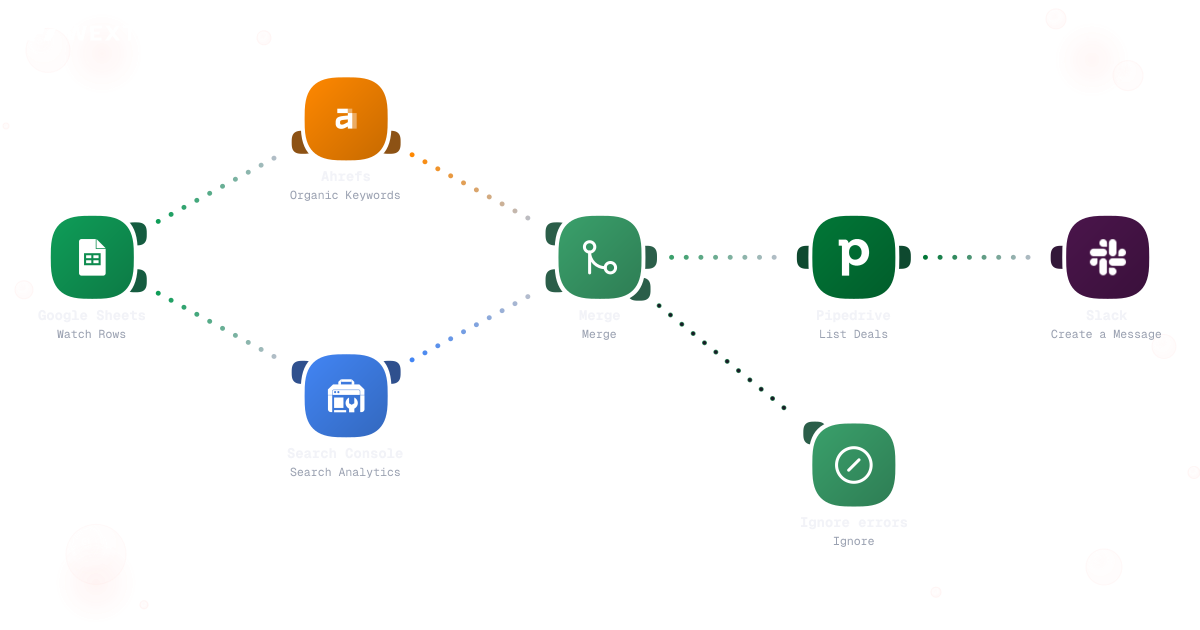
Branched workflow gathering campaign metrics from several sources, filtering them, and routing failures separately.
- GDPR
- Data Encryption
- 2FA
- Local Data Region
Marketing automation, at a glance
What marketing teams build first
Four workflows our marketing users tend to start with. Clone one from the template gallery, or sketch your own on the canvas.
The Monday report builds itself
Pull spend and results from every channel into one summary, on a schedule you set.
- Trigger — a schedule fires (Monday morning by default), or spend on a live campaign crosses a pacing threshold mid-week and triggers an out-of-cycle check.
- Information collected — spend, impressions, clicks, and conversions per ad platform, organic clicks from search, and pipeline value from the CRM, all normalized to the same date range.
- Connected applications — Facebook for paid performance, Google Analytics for site conversions, Google Search Console for organic, Salesforce for pipeline value, Slack for delivery.
- Decision logic — normalizes currency and reporting windows across platforms, then flags any channel where cost-per-conversion moved past the saved threshold instead of burying it in a row.
- AI step — drafts a two-sentence explainer of what changed and which campaign drove it.
- Human approval — a flagged cost spike or a channel with no data this week routes to the campaign owner before the digest posts; routine numbers post on their own.
- Actions — posts the digest to Slack and logs a summary row to Google Sheets so the trend line has history.
- Exception handling — if a platform's API is down at report time, the digest ships with a 'data unavailable for [platform]' note and a retry, instead of a silently wrong total.
Branched workflow gathering campaign metrics from several sources, filtering them, and routing failures separately.


What a marketing team actually loses a week to
None of this is complicated. A form fill and a paid click carry a campaign, medium, and source — right up until someone re-types the lead into the CRM by hand and the attribution stays behind in the ad platform. A Monday report needs five exports lined up before 9am whether or not Friday left time to build it. A social post is 'ready' the moment someone stops asking about it in Slack, not the moment someone actually approved it.
- Step 1
Attribution dies at the CRM
UTM data survives the click but not the copy-paste into the CRM record.
- Step 2
The Monday scramble
Five exports, four tabs, one report due before the team logs in.
- Step 3
Chasing a 'yes' in Slack
Approval status lives in someone's memory, not the content calendar.
None of it needs a strategist's judgment. All of it needs to happen the same way every single week.
Example: automate the Monday campaign report
A concrete run, start to finish — the kind of reporting workflow a marketing ops person clones from the template library and points at their own ad accounts.
Trigger: a schedule fires early Monday morning, or spend on a live campaign crosses a pacing threshold mid-week and needs an out-of-cycle check.
WEXTL pulls: spend, impressions, clicks, and conversions from every connected ad platform, organic performance from search, and pipeline value from the CRM for the same date range, normalized to one currency and one reporting window.
Human judgment
A cost spike, a channel with no data this week, or a number that contradicts last week's trend routes to the campaign owner instead of shipping in the digest as fact. The workflow assembles the report; a person decides what a spike means.
Example: automate lead capture with attribution
The same discipline, applied to the form-to-CRM gap: nothing about a lead's source should depend on a person remembering to type it in.
Trigger: a form is submitted — a gated content download, a paid social lead form, or a landing page's contact form.
Sources combined: form fields, the UTM parameters on the referring URL, the ad platform's own lead ID when the form came from a lead ad, and any existing CRM record matching that email or phone.
Human judgment
A lead with no UTM data, a form submission that doesn't match any live campaign, or a contact whose match confidence is low gets tagged 'needs attribution review' instead of a guessed source — a person confirms it, the workflow doesn't invent one.


The click that started it, still attached at the CRM
A lead form on a paid social ad and a CRM record are two different systems with two different ideas of 'done.' The gap between them is where campaign, medium, and ad set quietly disappear.
Wire the lead ad directly to the CRM and the source rides along — no export, no re-entry, no 'source: unknown' six weeks later when someone asks what drove the deal.
- Step 1
Source survives the handoff
Campaign, ad set, and form ID land on the CRM record, not just the contact's name.
- Step 2
No export step
The record exists the moment the form is submitted, not at end of day.
- Step 3
Duplicates matched, not multiplied
An existing contact gets updated instead of a second row for the same person.
Who marketing workflow automation is for
Not every marketing function needs this on day one. It earns its keep where campaigns, channels, or data sources multiply faster than the team running them.
Demand gen running multi-channel campaigns
— The same lead needs the same attribution whether it came from paid social, search, or a webinar form.Growth and paid acquisition marketers
— Spend and performance live in three or four ad platforms that don't talk to each other natively.Content and social managers
— One piece of copy, several channels, each with its own format and posting schedule.Marketing ops maintaining reporting
— The team that owns 'why don't these two dashboards agree' every single week.Customer marketing and comms
— Reading NPS and review-site comments at a volume no one reads by hand.Small teams wearing every hat
— No dedicated ops role, so the busywork has to run itself or it doesn't get done.
WEXTL isn't a replacement for your ad platforms, your CRM, or your content calendar — it's the layer that keeps them agreeing with each other, so the team spends its time on strategy and creative instead of reconciling exports.
Connect the tools your marketing stack already runs on
No two marketing teams pick the same stack, and this isn't asking you to switch. These are the integrations marketing workflows on WEXTL actually use — an HTTP step reaches anything else with an API.


