


Close the books without closing the week
Month-end used to mean exports, pivots, and chasing approvers in chat. WEXTL runs the close checklist on a schedule — collect, reconcile, route approvals, and post the pack where leadership already reads.
Deploys this workflow into your workspace — you'll connect your own accounts.
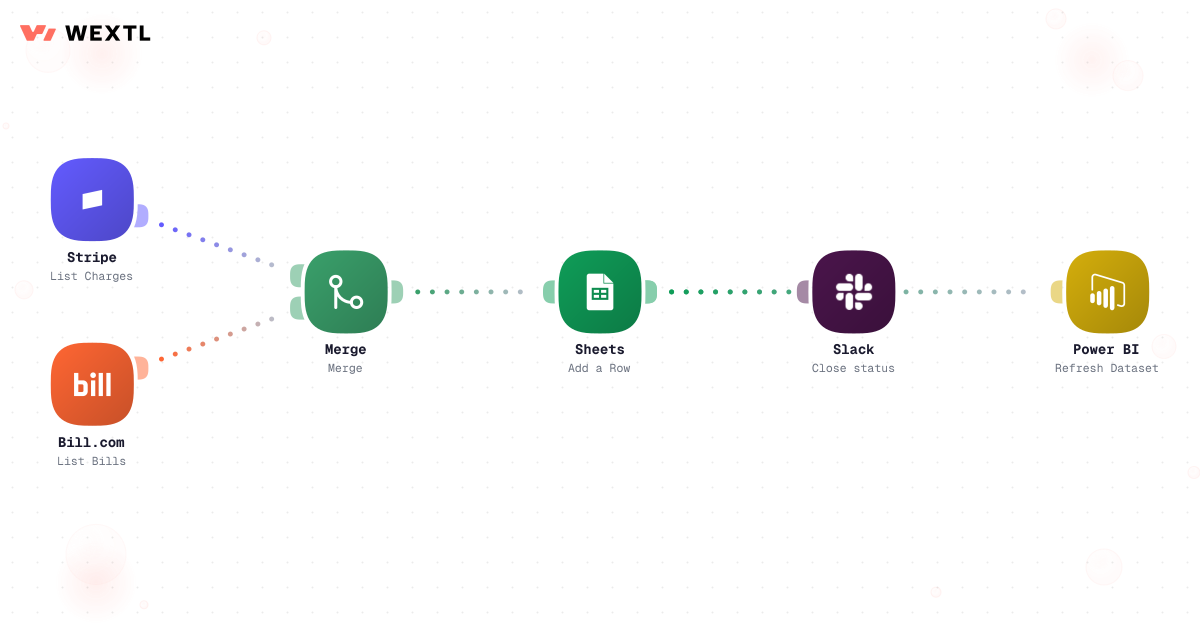
Workflow aggregating billing and AP sources into a close spreadsheet and status message
- GDPR
- Data Encryption
- 2FA
- Local Data Region
- 40+
- close-checklist lines chased across inboxes
- 3
- approval routes checked before a bill pays
- 0
- manual exports needed for the daily cash number
* Illustrative example, not measured customer data.
Finance automation, at a glance
What finance teams automate first
Four workflows finance teams clone and adapt — close, expenses, approvals, and cash visibility.
Month-end that runs itself
Pull charges, bills, and ledger rows into one close pack on the calendar you set.
- Trigger — the close-cadence date arrives (for example, the 1st business day after month-end) or a controller starts the close manually from the workflow.
- Information collected — open AP bills, unposted Stripe/Chargebee billing charges, the prior month's checklist status, and any accrual flagged incomplete last cycle.
- Connected applications — Bill.com for AP status, Stripe and Chargebee for billing charges, QuickBooks for the ledger balance, Google Sheets or Microsoft Excel for the close pack, Slack for status.
- Decision logic — each source total is compared against the matching QuickBooks ledger balance; a difference beyond a saved threshold (for example, 2%) is flagged for review instead of auto-cleared, and a checklist item only marks complete once its underlying reconciliation passes.
- AI step — drafts a one-line flux explanation candidate for each flagged variance, pulled from the underlying transaction detail.
- Human approval — every flagged variance and its flux note waits for the controller; nothing on the checklist closes itself.
- Actions — appends reconciled rows to the shared close-pack sheet, marks checklist items complete, and posts close status to the channel the controller specified.
- Exception handling — a source that fails to respond (a Bill.com timeout, a stale Stripe pull) marks that checklist step "blocked" and pings the AP owner instead of marking it complete with incomplete data.
Workflow aggregating billing and AP sources into a close spreadsheet and status message


What a controller actually fights every close
None of it is hard. It's just that the close checklist runs forty-some line items deep, and every one depends on someone else's inbox — an AP owner who hasn't uploaded bills yet, a subledger export that's a day stale, a CFO who's on a plane when a $40k invoice needs a signature. A cash number for the Monday leadership sync gets rebuilt from three separate exports because the dashboard nobody trusts is two clicks slower than just doing it by hand again.
- Step 1
A 40-line checklist with no owner map
Each item waits on a different person's inbox, and nothing pings them automatically.
- Step 2
An invoice stuck on one inbox
A five-figure bill waits on a single approver instead of a documented threshold.
- Step 3
A cash number rebuilt by hand
Three exports, every Monday, because the dashboard is slower to trust than to redo.
WEXTL doesn't close your books or approve your invoices — it does the pulling, matching, and routing so close and AP staff spend the week on the judgment calls, not the exports.
Example: automate month-end close reconciliation
A concrete run, start to finish — the kind of close workflow a controller clones from the template library and adjusts to their own chart of accounts.
Trigger: the close-cadence date arrives (the 1st business day after month-end, or whatever date the controller sets) and the workflow pulls last month's checklist as a template.
Sources combined: open and pending AP bills from Bill.com, billing charges from Stripe and Chargebee summed by GL code, and the corresponding QuickBooks ledger balance for each.
Human judgment
A flagged variance never auto-clears. The controller decides whether it's a timing difference, a booking error, or something that needs a journal entry — the workflow does the pulling and matching, the sign-off is a human's.
- Step 1
1. Checklist opens
The close-day trigger fires and pulls the prior month's checklist as a template.
- Step 2
2. Pull AP and billing data
Open, unpaid, and pending-approval bills come from Bill.com; Stripe and Chargebee charges are summed by GL code.
- Step 3
3. Match to the ledger and flag variances
Each source total is compared against QuickBooks; a difference beyond a saved threshold (say, 2%) is marked for review, not auto-cleared.
- Step 4
4. Draft the flux note
AI proposes a one-line explanation for each flagged variance from the transaction detail.
- Step 5
5. Hold for controller review
Every flagged line and its flux note waits for a human before the checklist item can close.
- Step 6
6. Post the pack and log the run
Reviewed rows and status append to the shared close-pack sheet, with every pull, match, and flag recorded.
Example: automate invoice approval routing
The same logic, applied to AP: route by risk and amount, not by whoever happens to check email first.
Trigger: a bill posts in "awaiting approval" status in Bill.com or QuickBooks.
Checked against: the vendor's history and last three approved amounts, the assigned cost-center budget owner, and the CFO-set approval-ceiling table.
Human judgment
A vendor changing its bank or ACH details, a bill from a brand-new vendor, or anything over the CFO-set ceiling always goes to a named person — never the auto-approve cap. The workflow proposes a route; a person still says yes.
Who finance automation is for
Not every finance role needs this on day one. It's built for the parts of the job that repeat across a lot of vendors, a lot of entities, or a lot of reconciling.
Controllers running a monthly or multi-entity close
— The same checklist-and-reconciliation logic runs per entity, not once.AP managers processing high invoice volume
— Enough vendors and bills that a threshold table beats a single inbox.FP&A analysts who rebuild a cash snapshot by hand
— The same billing-plus-pipeline pull, done manually every morning.Bookkeepers juggling several client ledgers
— The same intake-and-coding pattern, repeated once per client.Finance ops at usage-billed or subscription businesses
— Reconciling billing charges to revenue recognized in the ledger, every cycle.Treasury or finance leads who need a same-day cash number
— Bank, billing, and pipeline balances without a manual export chain.
Vendor bills become ledger rows without retyping
A receipt forwarded to AP shouldn't require anyone to retype a vendor name, an amount, and a GL code by hand.
Watch the inbox, extract the bill, create it in Bill.com, and append the ledger row — while the vendor's email is still on screen.
- Step 1
AP
Receipts become coded bills without retyping line items.
- Step 2
Budget owners
Notified only when a bill needs a human decision.
- Step 3
Finance
The ledger row lands the same hour the receipt arrives, not at month-end.


Connect the tools finance already uses
Finance doesn't get to pick a new stack for this — the ledger, the AP tool, and the billing system are fixed, and whatever automates the close has to meet them where they are.
These are the integrations most finance workflows actually use. An HTTP step reaches an ERP or bank feed without a native connector.
- QuickBooksThe ledger of record — reconciliation targets and posted journal entries.
- Bill.comAP status, bill creation, and approval routing for every incoming invoice.
- StripeBilling charges pulled by GL code for close reconciliation and the cash snapshot.
- ChargebeeSubscription billing charges reconciled against the ledger the same way.
- MercuryBank balances feeding the daily cash snapshot alongside billing.


