


From inbox to paid — with approvers in the loop
AP lives in email threads: intake, manager sign-off, payment, and audit scattered across tools. WEXTL chains those steps on a canvas — extract invoices, route by policy, pay vendors, and log every handoff.
Deploys this workflow into your workspace — you'll connect your own accounts.
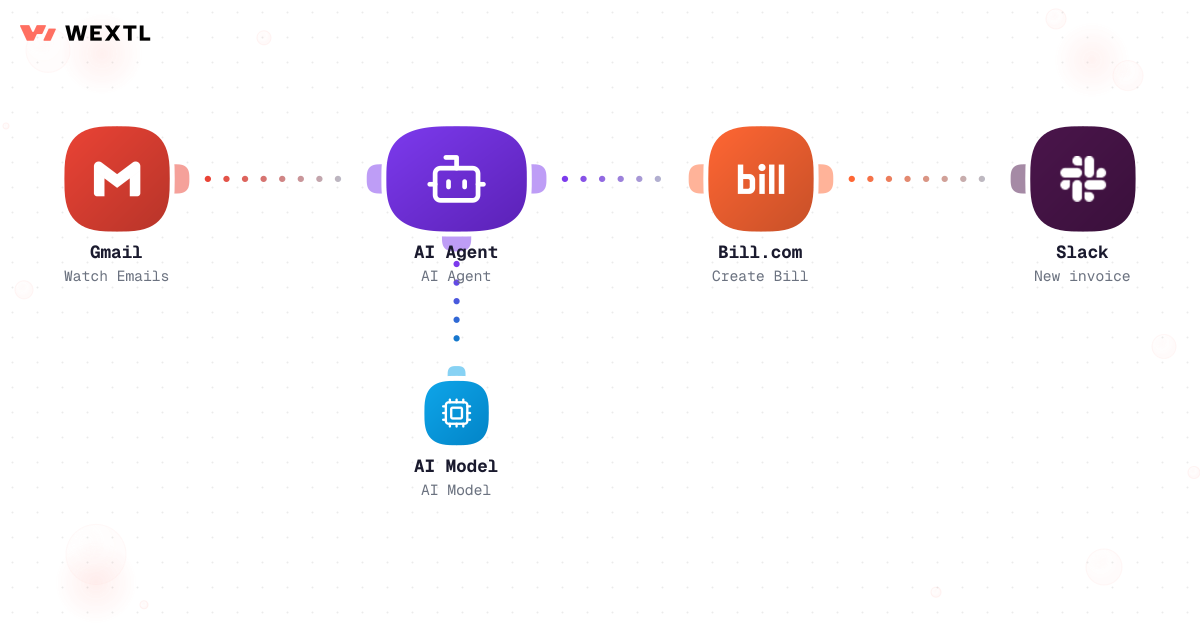
AI-assisted invoice intake from email to bill creation
- GDPR
- Data Encryption
- 2FA
- Local Data Region
- 23
- invoices in the AP inbox before 9am
- 3
- separate approval chains, one per legal entity
- 4 days
- a six-figure invoice sits with an absent approver
* Illustrative example, not measured customer data.
Invoice approvals automation, at a glance
AP from intake to audit
Invoices from email to bill
Watch AP inbox, extract fields with AI, create bills, notify finance.
- Trigger — a new invoice arrives as an email attachment, a forwarded thread, or a PDF dropped into a shared Drive folder.
- Information collected — vendor name, invoice number, amount, line items, PO reference (if any), and due date.
- Connected applications — Gmail or Microsoft Outlook for the inbox, Google Drive for dropped or scanned PDFs, Bill.com or QuickBooks for the bill record.
- Decision logic — runs a 3-way match: the extracted invoice is checked against the referenced PO and the recorded receipt for quantity and price agreement before a bill is created.
- AI step — extracts vendor, invoice number, amount, line items, and PO reference from the document or email body.
- Human approval — a failed match, a missing PO, or low-confidence extraction holds the invoice for an AP clerk to confirm before any bill posts.
- Actions — creates the bill in Bill.com or QuickBooks, attaches the source PDF, and tags the GL code.
- Exception handling — a duplicate invoice number or amount from the same vendor is flagged before creation, not discovered after payment.
AI-assisted invoice intake from email to bill creation
What AP actually fights every close
On a bad Monday, twenty-three invoices land in the shared AP inbox before 9am — six as PDF attachments, four forwarded from someone else's inbox, the rest as portal downloads nobody remembers logging into. Reading them is the easy part.
A vendor resends an invoice because they think the first one got lost — now two bills exist for one shipment. GL coding happens from memory, not a rule. And a $40,000 invoice can sit for four days if the one person allowed to sign it is on a plane, because three different legal entities each run their own approval chain with no delegate on file.
Duplicate resends
A vendor resends because payment feels slow; nobody notices until two bills exist for one shipment.
The absent approver
A six-figure invoice sits for days because the one person who can sign it is out, with no delegate on file.
GL coding by memory
No rule decides the cost center — just whoever's been here long enough to remember how it was coded last time.
WEXTL doesn't approve invoices or decide who gets paid — it extracts, matches, and routes so the people with signing authority spend their time deciding, not chasing paperwork.
Example: automate invoice intake and 3-way match
A concrete run, start to finish — the kind of intake workflow an AP team clones from the template library and points at its own inbox and PO system.
Trigger: an invoice arrives — an email attachment, a forwarded thread, or a PDF dropped into a shared Drive folder.
WEXTL checks: the referenced PO for ordered items and price, the receiving record for whether goods or services were marked received, and the vendor's recent invoice history for a possible duplicate — before trusting the extraction enough to create a bill.
Human judgment
A failed match, a missing PO, or a possible duplicate never gets auto-created — it waits for an AP clerk to confirm the fields or track down the PO before a bill exists at all.
Example: automate approval routing against a delegation-of-authority matrix
The same discipline, applied to sign-off: route by who is actually allowed to approve what, for which entity, and escalate when they don't answer.
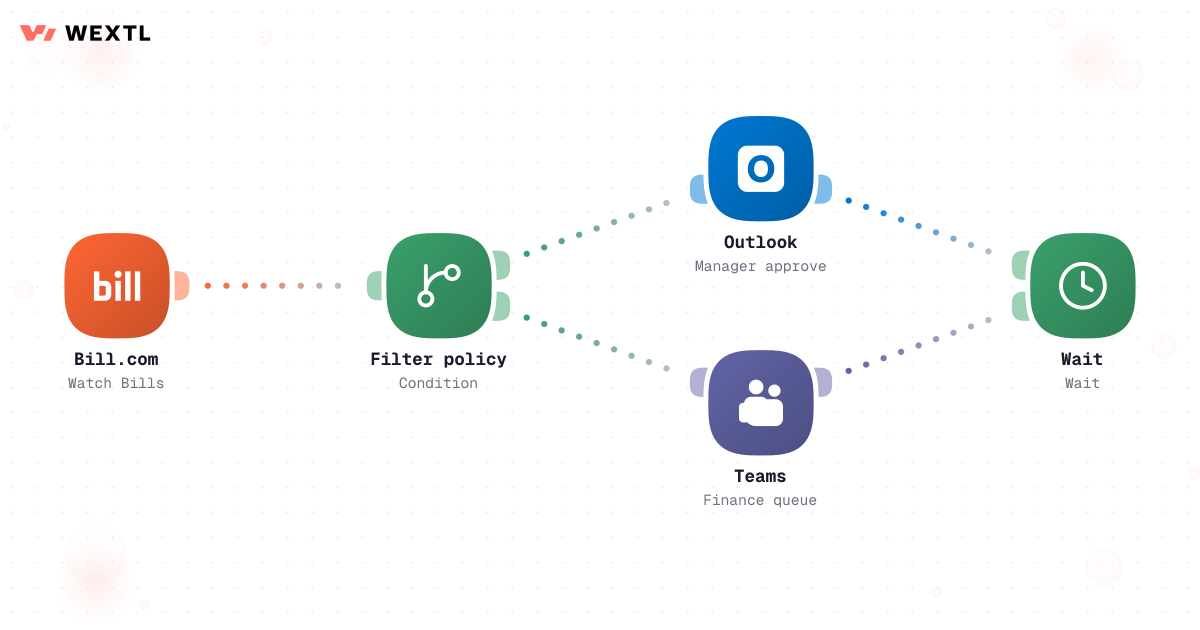
Trigger: a bill is created and needs sign-off before it moves to payment.
WEXTL checks: the DoA table for that legal entity, vendor risk flags (new vendor, changed bank account, price far above history), and how long the current approver has been waiting.
Human judgment
Every approval above the auto-approve floor is a real person's decision, not a rule guessing on their behalf — the workflow only decides who gets asked, and how long to wait before asking someone else.
Who invoice approval automation is for
Not every AP function needs this on day one. It's built for the parts of the job that repeat across a lot of invoices, a lot of approvers, or a lot of entities.
AP specialists processing high invoice volume
— Enough invoices a month that manual PDF intake is the bottleneck, not the approvals.Controllers running multi-entity approval chains
— Different DoA thresholds per legal entity or subsidiary, applied by rule instead of memory.Bookkeepers at small finance teams without dedicated AP staff
— One person covering intake, approval nudges, and payment with no backup.Procurement or finance ops enforcing 3-way match
— PO, receipt, and invoice have to agree before anything gets paid — and someone has to prove it.CFOs who need an audit-ready trail
— Evidence an invoice was matched, approved, and paid in the right order, without asking AP to rebuild it every quarter.Teams moving off PDFs and spreadsheets
— Replacing a shared inbox and a tracking sheet with real approval gates and a logged history.
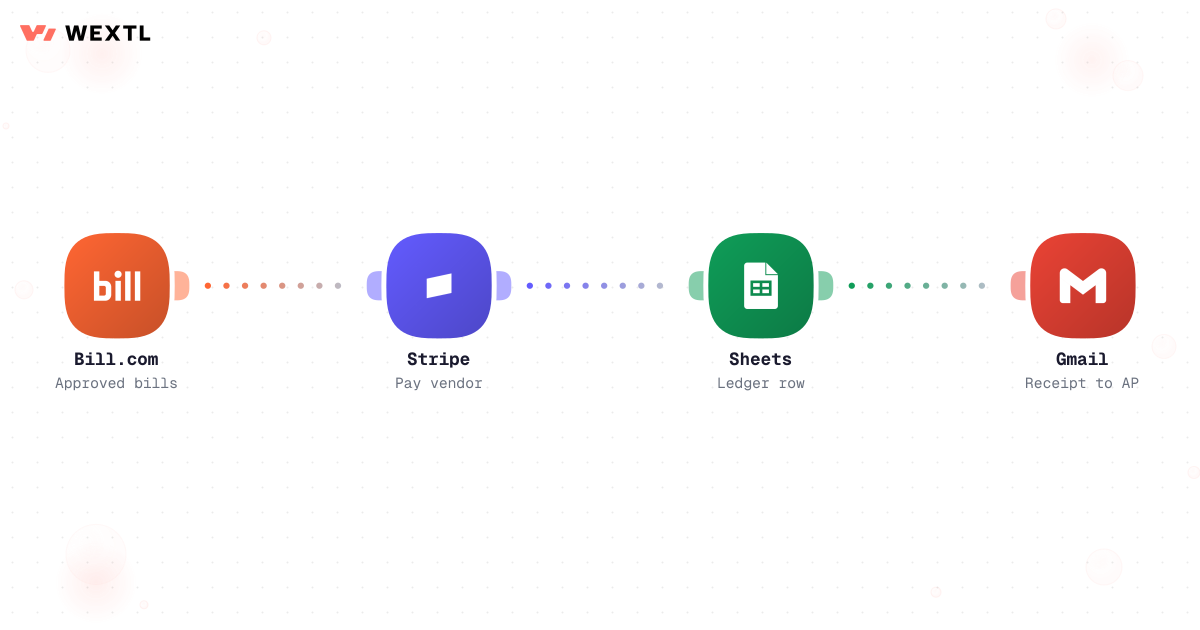
Paid without a chase, logged without a scramble
An approved bill still sits until someone remembers to push payment, and the ledger update lags behind by however long that takes.
On approval, the payment fires, the ledger updates, and the remittance goes out — in the same run, not a follow-up task someone has to remember.


Payment on approval
Fires the moment the bill clears its last required sign-off, not whenever someone gets to it.
Ledger row, same run
GL entry lands with the payment instead of a separate reconciliation pass.
Remittance sent
The vendor gets a confirmation without AP writing it by hand.
Connect the tools your AP process already runs on
You don't get to pick a clean-slate AP stack. The bill system, the inbox, and the approvers' chat tool are fixed — whatever you automate has to meet them where they are.
These are the integrations most invoice-approval workflows actually use. An HTTP step reaches anything else with an API.
- Bill.comBill creation, approval status, and payment execution — the system most of this workflow reads and writes.
- QuickBooksGL coding and the ledger of record once a bill is created or paid.
- TipaltiMass and international vendor payouts for AP teams paying vendors across currencies.
- WaveSame intake-to-payment logic for small finance teams running Wave instead of a full AP suite.


- GmailInvoice intake from vendor emails and approver notifications for teams on Gmail.
- Microsoft OutlookSame intake and notification logic for teams standardized on Outlook and Microsoft 365.
- Microsoft TeamsApproval prompts posted where approvers already work, with a real approve or reject action.
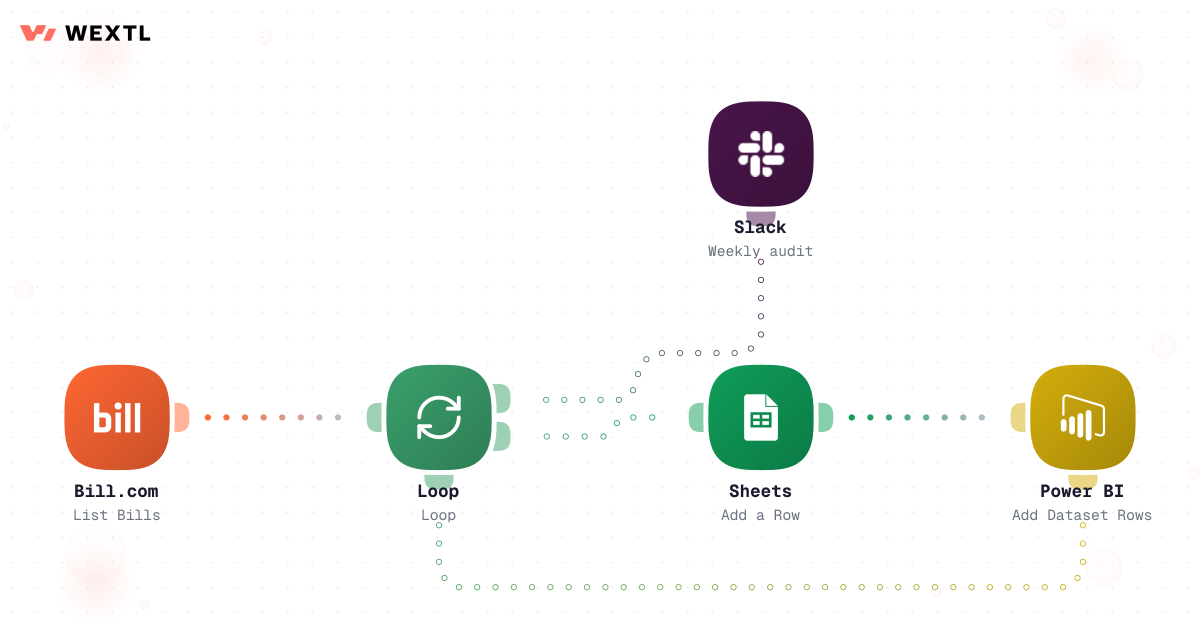
- SlackSame approval prompts and weekly audit digest for teams on Slack.


