


Every ticket triaged before you open it
Tickets get read, tagged, and routed the moment they arrive, so your team starts on the answer instead of the sorting. WEXTL sits between your help desk, CRM, and chat tools and keeps them telling the same story.
Deploys this workflow into your workspace — you'll connect your own accounts.
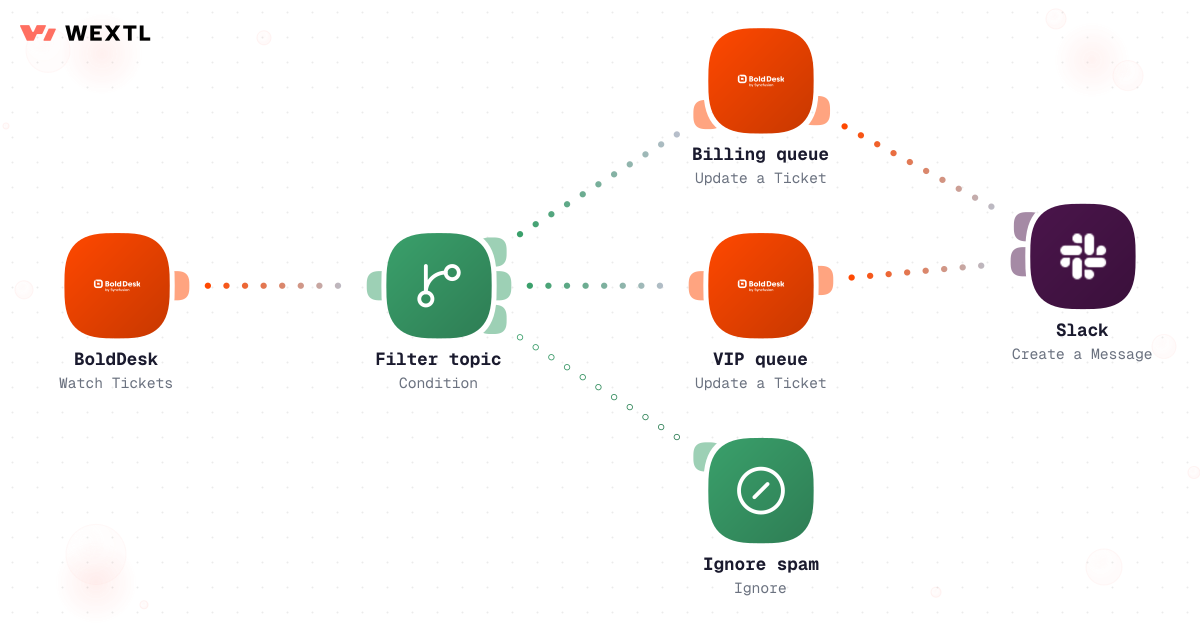
Preview of a branched workflow that filters incoming tickets and routes each one down a different path by topic and urgency.
- GDPR
- Data Encryption
- 2FA
- Local Data Region
- 40
- tickets in the overnight queue before triage
- 3
- duplicate tickets, one account, merged not split
- 1 hr
- for a low CSAT score to open a task, not next week
* Illustrative example, not measured customer data.
Customer Support automation, at a glance
What support teams automate first
Four workflows that give a support team its mornings back. Each starts as a template you can clone and adjust.
Sorted before the queue refreshes
Classification and routing run on every ticket the second it lands, around the clock.
- Trigger — a new ticket lands, from the inbox, the chat widget, or a social DM channel your help desk pulls into one queue.
- Information collected — sender, message body, channel, prior ticket history for that requester, and any tags already on the account.
- Connected applications — Zendesk, Freshdesk, Gorgias, Intercom, or Chatwoot for the ticket; Slack for routing alerts.
- Decision logic — matched against topic/intent (billing, bug report, refund, login/access), a sentiment score on the message, and account tier (VIP/enterprise list) to pick a queue.
- AI step — classifies the ticket and drafts a suggested macro reply from your library when the match is confident.
- Human approval — low-confidence classifications and tickets touching more than one topic go to a review queue instead of an auto-applied tag.
- Actions — applies tags, assigns to the right queue or skill-based agent group, and pins account context (plan, renewal date) to the ticket.
- Exception handling — a new ticket matching an already-open thread from the same requester merges into it instead of creating a duplicate; suspected spam is tagged and skipped.
Preview of a branched workflow that filters incoming tickets and routes each one down a different path by topic and urgency.


What a support queue actually does to a shift
None of it is hard. A billing question is not complicated. What's hard is that a queue fills overnight with forty tickets that look identical until you've opened all forty — three of them are the same complaint from the same account, filed an hour apart, because nothing dedupes them on the way in. A P1 lands on an engineer's desk as “customer is furious” instead of steps to reproduce, because whoever escalated it was moving too fast to write one down. And a customer who scored you 2 out of 5 last Tuesday is still sitting in the general queue today, because nobody connected the ticket to the score.
- Step 1
The overnight pile-up
Forty tickets in one queue, three of them the same complaint.
- Step 2
Escalations with no repro
”Customer is upset” reaches engineering instead of what broke.
- Step 3
A CSAT score nobody acts on
Logged in a dashboard, disconnected from the ticket that caused it.
None of it needs a person's judgment to sort. All of it still needs sorting.
Example: automate ticket triage and routing
A concrete run, start to finish — the kind a support lead clones from the template library and adjusts to match their own queue structure and SLAs.
Trigger: a new ticket lands — from the inbox, the chat widget, or a social DM channel your help desk pulls into one queue.
WEXTL checks: the sender's account tier and history, topic and intent (billing, bug report, refund, login/access), a sentiment score on the message, and whether the thread matches an already-open ticket from the same requester.
Human judgment
A ticket touching more than one topic, an account outside your VIP list making an unusual request, or a sentiment score the workflow can't resolve confidently gets parked for an agent instead of auto-tagged. The workflow sorts; a person makes the close call.
Example: automate an escalation to engineering
The same logic applied to the moment a ticket stops being a support problem and becomes an engineering one.
Trigger: an agent tags a ticket “escalate,” or a rule fires on its own — an SLA about to breach, three contacts on the same issue, or a sentiment score that drops sharply mid-thread.
Sources combined: the full ticket thread, the account's plan and prior escalation history, and any error text, screenshots, or logs attached to the conversation.
Human judgment
If on-call doesn't acknowledge within a set window, the workflow escalates to the next person in the rotation instead of sitting silent — but nothing is marked resolved, and no fix ships, without an engineer's own action.
WEXTL is not trying to replace the support team — it handles the sorting, summarizing, and syncing so agents spend their time on the ticket that actually needs a person, not the ninety that don't.
What support teams should not automate blindly
Refund approvals past a set amount, any reply to an account mid-renewal or flagged as a churn risk, and a ticket where the AI's classification confidence is low are exactly where automation should stop and hand back — not because the workflow can't attempt them, but because a wrong guess costs more than a slower right answer.
Where a human stays on
Anything that issues a refund past your threshold, any reply where account history matters more than the words in the ticket, and any escalation marked resolved. The workflow drafts, tags, and proposes for these — it does not decide.
Automate the sorting
Classification, routing, and duplicate-merging run without an agent touching them.
AI drafts, does not send
Auto-reply is an opt-in switch per topic, not the default for every ticket.
Humans keep the refund button
Anything past your dollar threshold stays a human approval.
Judgment showed up exactly where it mattered — the refund call, the angry VIP reply. Everything else just ran.
Who customer support automation is for
Not every desk needs this on day one. It's built for the parts of support work that repeat across a lot of tickets, a lot of channels, or a lot of accounts.
Tier 1 agents on a high-volume queue
— The same triage and routing logic runs on every ticket, not just the ones someone remembers to tag.Support leads running a multi-channel desk
— Email, chat, and social DMs normalized into one queue instead of three inboxes.On-call and escalation owners
— Reproduction detail attached automatically instead of retold from memory.Teams tracking churn risk from support signals
— Repeat contacts and falling CSAT on one account surfaced before renewal, not after.Ops and QA staff auditing ticket quality
— Every classification and routing decision logged, so quality review isn't guesswork.Teams running CSAT or NPS programs
— Surveys sent and scored on every resolution, not sampled once a quarter.


One account record, not two disagreeing ones
An agent quotes a plan limit from six weeks ago because the CRM changed and nobody told the help desk.
Plan and entitlement changes flow into the help desk automatically, and ticket volume plus CSAT flow back to the account record — so the account owner sees support pressure before the renewal call, not during it.
- Step 1
Plan changes sync down
Entitlement changes from the CRM reach the help desk automatically.
- Step 2
Ticket pressure syncs up
Volume and CSAT write back to the account record the CRM shows.
- Step 3
Risk surfaces before renewal
The account owner sees the pattern ahead of the call, not during it.
A score that reaches someone before the customer forgets why they gave it
CSAT usually surfaces in a monthly deck, disconnected from the ticket that caused it.
Send the survey on resolution and route a low score straight to Slack with the ticket attached — a follow-up can open the same hour, while the context is still fresh.


- Step 1
Survey on every resolution
Not sampled once a quarter — sent while the conversation is fresh.
- Step 2
Low scores ping Slack
The ticket travels with the score, not just a number in a report.
- Step 3
Trends build themselves
Rolled up by agent and topic without a spreadsheet.
Connect the help desk your team already runs on
You don't get to pick the help desk after the fact — whatever you automate has to meet your stack where it is.
These are the integrations most Customer Support workflows actually use. An HTTP step reaches anything else with an API.
- ZendeskTicket triage, routing, and macro replies for teams standardized on Zendesk.
- FreshdeskSame triage and SLA logic for teams running Freshdesk instead.
- GorgiasPurpose-built for e-commerce support — order and refund context pulled into the ticket.
- IntercomChat-first support with the same routing and escalation rules.
- ChatwootOpen-source help desk coverage for teams running their own stack.


