


Orders move. Inventory stays honest.
High-value orders, low stock, abandoned carts, and returns each need a different playbook — and they all touch Shopify, payments, and support. WEXTL runs those playbooks on the canvas so nothing waits on someone checking admin.
Deploys this workflow into your workspace — you'll connect your own accounts.
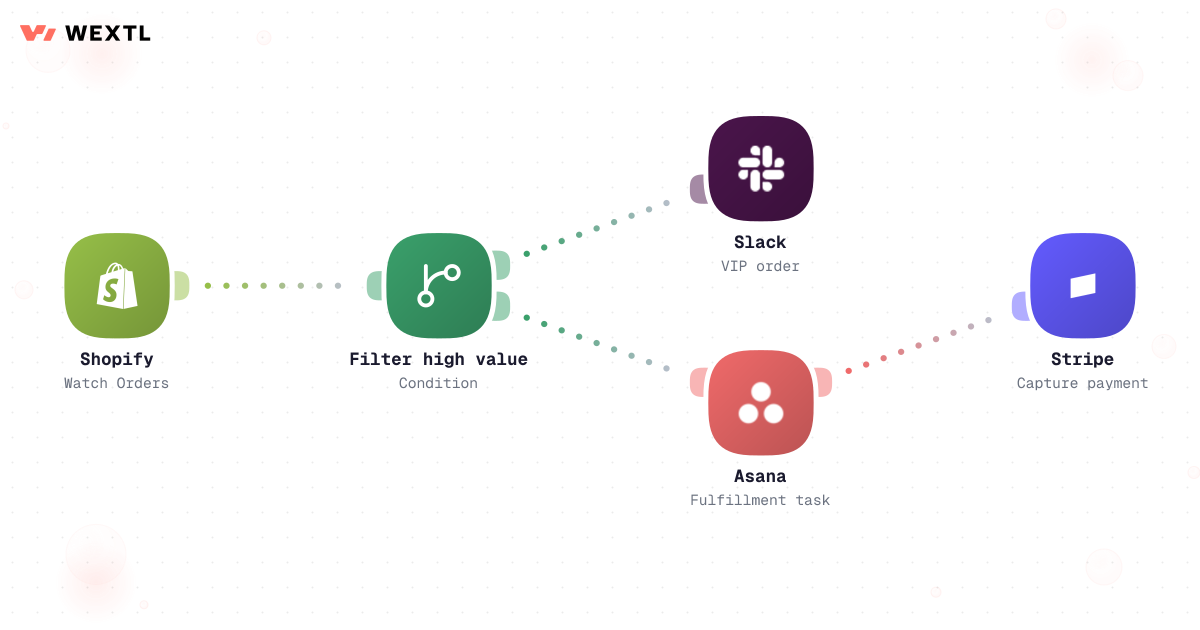
Shopify order workflow with Slack alert and fulfillment task
- GDPR
- Data Encryption
- 2FA
- Local Data Region
- 3
- sales channels reconciled to one stock count
- 60 sec
- to route a new order to the right warehouse
- 48 hrs
- a return sits in a shared inbox before automation
* Illustrative example, not measured customer data.
Ecommerce automation, at a glance
Store ops on autopilot
Route high-value orders fast
Filter order value, notify Slack, create fulfillment tasks, and capture payment.
- Trigger — a new order completes checkout on Shopify, WooCommerce, or Squarespace and payment authorizes.
- Information collected — order value, SKU list, shipping vs. billing address, and the customer's order history or VIP tag.
- Connected applications — Shopify or WooCommerce for the order event, Stripe for payment capture, ShipBob, ShipMonk, or ShipEdge for warehouse stock and fulfillment tasks.
- Decision logic — checked against the VIP value threshold, an address-mismatch and order-velocity fraud score, and which connected warehouse actually holds the SKU closest to the shipping address.
- AI step — drafts the customer-facing delay note when a line item is backordered or a shipment has to split across two warehouses.
- Human approval — orders with a fraud-risk flag, an address mismatch, or a split shipment hold for review before payment captures or a fulfillment task is created.
- Actions — captures payment, creates the fulfillment task at the chosen warehouse, tags VIP orders, and posts high-value orders to Slack.
- Exception handling — no warehouse has full stock: the order splits or backorders instead of silently shipping partial, and gets flagged for a person to confirm.
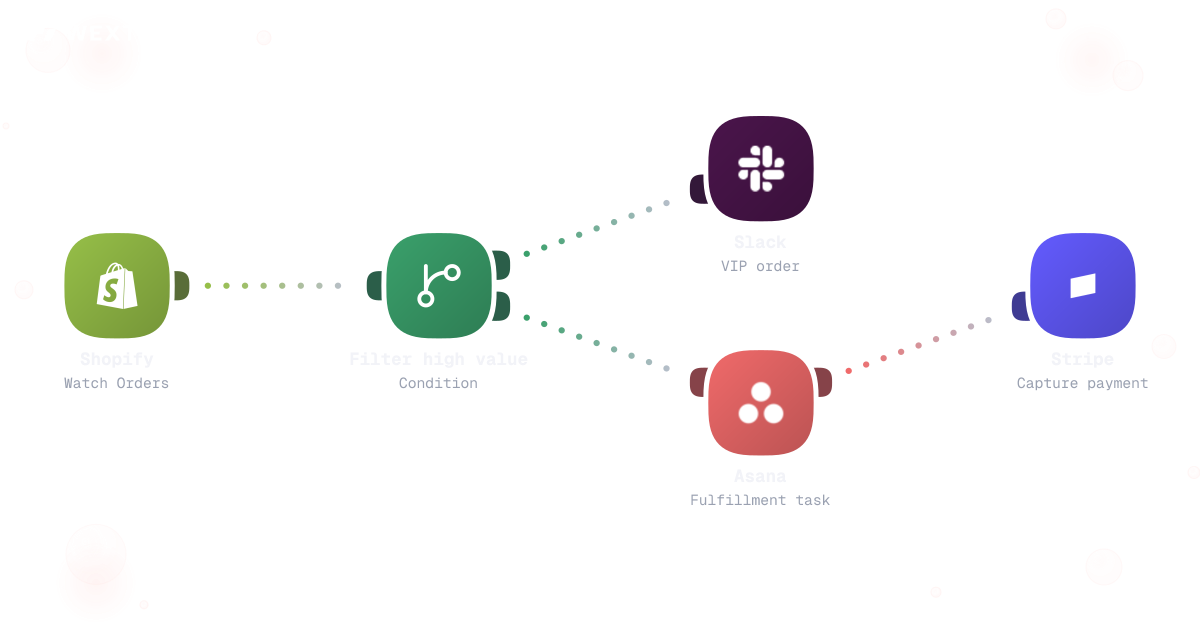
Shopify order workflow with Slack alert and fulfillment task


What running ecommerce ops actually fights every day
None of it is hard. It's just relentless, and it never happens on one screen. A SKU sells out on the storefront twenty minutes before the warehouse feed catches up, and three more orders land for stock that's already gone. A return request drops into a shared inbox and sits for two days because nobody owns Friday triage. A cart abandons at 11pm and either gets three emails in an hour or none at all, depending on who remembers to check.
Three sales channels, one stock count, and a support inbox that doesn't know which order a customer means until someone looks it up.
- Step 1
Oversell across channels
Storefront and warehouse disagree for twenty minutes and three orders land for stock that's already gone.
- Step 2
Cart recovery: spam or silence
With no wait logic it's either three emails in an hour or none at all.
- Step 3
Returns stuck in a shared inbox
A return request with no owner sits for two days before anyone opens it.
WEXTL is not trying to replace the ops team — it handles the repetitive routing and reconciliation work so ops can spend more time on the exceptions, the supplier relationships, and the decisions that actually need a person.
Example: automate order routing and fraud-risk capture
A concrete run, start to finish — the kind of order-routing workflow a store clones from the template library and tunes to its own fraud tolerance and warehouse footprint, routing to the right warehouse in under a minute.
Trigger: a new order completes checkout on Shopify, WooCommerce, or Squarespace and payment authorizes.
WEXTL checks: order value against the VIP threshold, whether billing and shipping addresses match, order velocity from the same card or device, which connected warehouse or 3PL (ShipBob, ShipMonk, or ShipEdge) actually holds the SKU, and whether any line item is backordered.
Human judgment
A fraud-score flag, an address mismatch, or a split shipment that needs a customer explanation routes to a person instead of auto-capturing. The workflow proposes the routing; a person clears the exceptions.
1. Order placed
— Checkout completes on the storefront and payment authorizes; order value, SKU list, and shipping details arrive with it.2. Score fraud risk and VIP status
— Flags address mismatches and unusual order velocity, then checks value and history against the VIP threshold.3. Pick the warehouse
— Checks stock across every connected 3PL and routes to whichever location can ship fastest.4. Draft the exception note
— AI writes the customer-facing delay message when a line item is backordered or split across shipments.5. Hold flagged orders
— Fraud-risk and split-shipment orders wait for a person before capture and fulfillment fire.6. Capture, fulfill, and log
— Payment captures, the fulfillment task is created at the chosen warehouse, and every decision is recorded.
Example: automate abandoned-cart recovery without becoming spam
The same logic, tuned for timing instead of routing: wait long enough to be sure, check before every send, and stop the moment the customer converts.
Trigger: a checkout starts and stalls — cart items added, payment step never completed.
Signals checked: whether the order completed since, marketing opt-in and channel (email or SMS), and whether this cart has already redeemed a recovery discount code more than once.
Human judgment
A high-value cart or a customer with a discount-abuse pattern routes to a person instead of getting an automatic code. The workflow drafts and waits; a person decides the edge cases.
Who ecommerce automation is for
Not every store needs this on day one. It's built for the parts of running commerce that repeat across a lot of orders, a lot of SKUs, or a lot of channels.
DTC brands selling on more than one channel
— Shopify, a marketplace, and a wholesale portal that all need the same stock count.Ops teams running their own or a 3PL warehouse
— Stock, reorder points, and shipping rules that live across ShipBob, ShipMonk, or an in-house team.CX teams owning returns and refunds
— RMA volume high enough that a shared inbox stopped working months ago.Merchandising managing SKU-level reorder rules
— Hundreds of SKUs, each with its own safety-stock threshold and supplier lead time.Lifecycle marketers running cart and post-purchase flows
— Recovery, win-back, and replenishment sends that need real order state, not a static list.Finance reconciling orders, refunds, and payouts
— Order and refund records that need to land in the books without a manual export.
What not to automate blindly in ecommerce
Fraud-flagged orders, refunds above a set amount, chargebacks, and any decision to discontinue or mark down a SKU are exactly where automation should stop and hand back to a person — not because the tooling can't attempt them, but because getting them wrong costs more than a slower, correct answer.
Where a human stays on
Anything that captures payment on a fraud-flagged order, any refund past the auto-approve limit, any chargeback response, and any call to write off inventory. The workflow flags and proposes for these — it does not decide.
Automate the routing
Standard orders, standard returns, and standard recovery sends run without a person touching them.
AI flags, does not resolve
Fraud scoring and return classification surface the exception; a person makes the call.
Humans keep the refund button
Anything past the auto-approve threshold stays a human decision.
Connect the tools a store already runs on
A store doesn't get to pick its stack from scratch. The storefront, the payment processor, and whichever warehouse ships the orders are already fixed — automation has to meet them where they are.
These are the integrations most ecommerce workflows actually use. An HTTP step reaches a custom checkout or in-house WMS with no native connector.
- ShopifyOrder, inventory, and checkout-abandonment events for the primary storefront.
- WooCommerceSame order and stock triggers for stores built on WordPress.
- StripePayment capture, refunds, and dispute data for the order record.
- SquarePOS and online order sync for stores that also sell in person.
- ShipBobFulfillment tasks, warehouse stock, and shipping status from a 3PL.
- ShipMonkSame fulfillment and inventory sync for stores warehoused with ShipMonk.
- QuickBooksOrders and refunds reconciled into the books without a manual export.


