


Reach every lead before it goes cold
Speed wins deals, and busywork is where speed dies. WEXTL routes leads in seconds, keeps your CRM honest, and nudges follow-ups so nothing slips through.
Deploys this workflow into your workspace — you'll connect your own accounts.
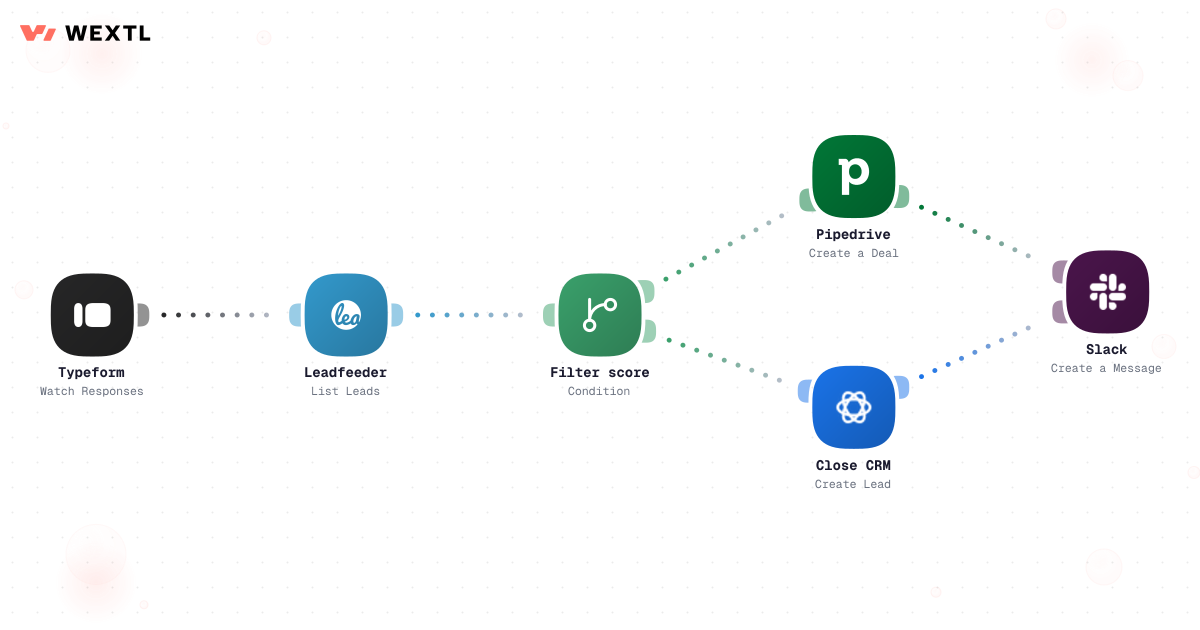
Preview of a branched workflow that filters incoming leads and routes each one down a different path by score and territory.
- GDPR
- Data Encryption
- 2FA
- Local Data Region
- 60 sec
- to route and assign a new inbound lead
- 20 min
- of CRM logging by hand, saved every day
- Day 3
- default cadence for a quiet deal's next nudge
* Illustrative example, not measured customer data.
Sales automation, at a glance
What sales teams automate first
The four workflows that pay for themselves fastest. Each one starts as a template you can clone.
Right rep, under a minute
Score and route every inbound lead the moment it arrives, day or night.
- Trigger — a new lead arrives from a web form, an ad campaign, a chat widget, or an inbound email.
- Information collected — company domain, employee count or deal-size signal, territory/region, and lead source.
- Connected applications — Salesforce or Pipedrive for the record, Seamless.AI or UpLead for firmographic enrichment when form fields are thin, Slack for the owner ping.
- Decision logic — matched against saved territory maps and named-account lists first; anything unmatched falls to a round-robin queue weighted by rep capacity, then filtered by a minimum lead-score threshold before assignment.
- AI step — scores the lead from firmographic and behavioral signals and drafts the rep's first-touch note with the enrichment context already filled in.
- Human approval — enterprise-tier leads and anything above a configured deal-size threshold route to the sales manager for a reassignment check before the rep is notified.
- Actions — sets the owner field, creates a follow-up task, and posts the assignment to the rep's Slack channel.
- Exception handling — a lead with no matching territory, or a domain that already has an open deal, is held in a review queue instead of getting assigned twice.
Preview of a branched workflow that filters incoming leads and routes each one down a different path by score and territory.


What a sales rep actually fights all day
None of it is hard. A lead sits in a shared queue for forty minutes because whoever usually claims them is in a demo. A deal hasn't been touched in nine days but nobody notices until forecast review. A prospect replied Tuesday and the sequence still fired step four on Thursday.
- Step 1
Leads sit in a queue
Whoever refreshes the list first claims it — or nobody does for forty minutes.
- Step 2
CRM entry at day's end
Twenty minutes of typing what already happened, from memory.
- Step 3
A sequence that doesn't know
Step four sends two days after the prospect already replied.
WEXTL is not trying to close the deal for the rep — it handles the routing, the record-keeping, and the repetitive follow-up so the rep spends time on the conversations that actually move a deal.
Example: automate inbound lead routing
A concrete run, start to finish — the kind of routing workflow a sales-ops lead clones from the template library and tunes to match how territories are actually split.
Trigger: a new lead arrives from a web form, an ad campaign, or an inbound email.
WEXTL checks: the lead's domain against named-account and territory lists, employee count or deal-size signal from enrichment, current rep capacity in the round-robin queue, and any VIP or partner-referral rules configured for specific sources.
Human judgment
A lead that matches two territories, an enterprise-tier account, or a source outside the configured rules routes to a sales manager instead of getting auto-assigned. The workflow proposes the match; a person confirms the exceptions.
- Step 1
1. Lead arrives
A form fill, ad click, or inbound email starts the run.
- Step 2
2. Enrich the record
Fills in company size and domain details when the form left them blank.
- Step 3
3. Match territory, or fall to round robin
Checked against saved region maps and named-account lists first; anything unmatched queues to the next rep by capacity, not by who refreshed fastest.
- Step 4
4. Draft the first-touch note
AI writes the rep's opener with the enrichment context already in it.
- Step 5
5. Hold enterprise-tier leads
Above a configured deal size, a manager checks the assignment first.
- Step 6
6. Assign and notify
Owner field is set and the rep gets pinged in Slack.
Example: automate the quote-to-cash handoff
The same logic, applied to close: turn a signed deal into an invoice or a subscription without a rep emailing finance the numbers by hand.
Trigger: a deal is marked Closed Won, or a proposal comes back signed.
Sources combined: the deal record's amount and terms, the signed document's line items, and whether the account is flagged PO-required or subscription.
Human judgment
A missing PO number, a discount outside the standard range, or a mismatch between the CRM amount and the signed document holds the invoice for finance instead of sending it with a gap.
Who sales workflow automation is for
Not every sales role needs this on day one. It's built for the parts of the job that repeat across a lot of leads, a lot of deals, or a lot of systems.
SDRs and BDRs running outbound
— The same sequencing and reply-detection logic runs across hundreds of prospects, not one inbox.AEs closing complex deals
— Quote-to-cash handles the paperwork so the rep stays on the call, not chasing finance.RevOps and sales ops
— Territory rules, scoring thresholds, and duplicate logic live on a canvas the team can actually audit.Sales managers assigning territory
— Named-account and round-robin rules apply the same way every time, not by who's fastest to claim a lead.Deal desk and finance-adjacent reps
— PO checks and discount thresholds catch problems before an invoice goes out wrong.Teams running inbound and outbound together
— Lead scoring and sequence logic share the same CRM record instead of two disconnected tools.
A pipeline you can actually trust
Stale deals pile up because nobody has time for Friday CRM cleanup, and a forecast built on nine-day-old activity is just a guess with a dollar sign.
A hygiene workflow loops open deals, checks recent activity against a stale threshold, and nudges the owner before the number reaches the forecast call.


- Step 1
Stage changes trigger the check
A deal that skips activity for 14 days gets flagged, not forgotten.
- Step 2
Duplicates get caught early
Same-domain records queue for a confidence-checked merge instead of splitting history.
- Step 3
Owners get nudged, not blamed
A Slack ping names the specific gap, not a generic 'update your deals' reminder.
Connect the tools a sales team already runs on
You don't get to pick the CRM after the fact. Whatever's already the system of record — Salesforce, Pipedrive, Close — is what routing, hygiene, and quote-to-cash have to write to.
These are the integrations most Sales workflows actually use. An HTTP step reaches anything else with an API.


